One of the most common questions we hear is: “What’s the difference between SSI and SSD?”
While both programs fall under the umbrella of Social Security disability benefits, they serve very different purposes and have different eligibility requirements. Understanding the key distinctions can help you or a loved one determine the right path to financial support.
What Is SSI?
SSI (Supplemental Security Income) is a needs-based program. That means your eligibility depends largely on your household income and assets, not just your own, but that of anyone living in your home.
To qualify for SSI:
You must be disabled.
You cannot own more than one house and one car.
You cannot have more than $2,000 in a bank account.
You cannot have assets that can be easily converted to cash (like insurance policies or tools).
Importantly, SSI benefits cannot be paid for any time before your application date. And if you’re eligible for any other type of payment, early retirement, insurance payouts, etc., you must apply for those as well.
What Is SSD (SSDI)?
SSD (also referred to as SSDI or Social Security Disability Insurance) is based on your work history. If you paid into Social Security through your job, you earned credits (up to 4 per year).
To be eligible:
You must have earned enough work credits. (You need 20 out of 40 quarters of coverage to be insured.)
You must prove you became disabled before your credits expired (this is called your Date Last Insured).
You must have worked and paid in to social security at least five of the last ten years before your disability began
SSD benefits can be paid retroactively for up to one year before your application date, but you won’t receive payments for the first five months of your disability. Your SSD amount is based on how much you paid into Social Security over your working years.
Additional Key Points
If you’re approved for even $1 of SSI, you’re automatically eligible for Medicaid.
SSD recipients become eligible for Medicare after 29 months (a 5-month waiting period plus 2 years).
The maximum SSI benefit in 2025 is $967 per month.
If you qualify for both SSD and SSI, you’ll receive the higher of the two benefits, not both combined.
SSI is impacted by all sources of income, including inheritances, lottery winnings, and even the sale of personal items.
If you try to “spend down” assets below market value to qualify for SSI, it may result in a delay penalty.
When applying for both programs, SSI is processed first, and Social Security will contact you directly to review your income and resources.
Need Help Navigating the Disability Process?
Understanding your eligibility and maximizing your benefits can be overwhelming. That’s where we come in. The advocates at Disability Help Group are here to guide you through every step of the process and help ensure you receive the benefits you deserve.
Call us today for a FREE consultation at (800) 800-3332 or click here to fill out our contact form. We’re here to help!
This article was written and fact-checked by Jennifer Walker, a Senior Disability Advocate with extensive experience in Social Security disability. All information reflects current SSA guidelines and real-world case knowledge to help you better understand your rights and options.
I Was Wrongfully Denied Disability: What Should I Do?
If you have been denied Social Security Disability Benefits (SSDI) and believe you should have been eligible, you are far from alone. More than 60% of Social Security Disability claims are initially denied. Many people who are initially denied disability benefits ultimately win benefits on appeal. However, that requires prompt action after you receive a denial notice.
Too many people miss their window to request reconsideration or request a hearing before an administrative law judge (ALJ). Most people who miss their opportunity to appeal can apply for disability benefits again. However, when that happens, you lose back benefits, potentially thousands or even tens of thousands of dollars. And, depending on when you last worked and when you became disabled, you could lose eligibility entirely.
First Steps After You’ve Been Denied Disability
The first thing you should do when you’ve been denied disability is to check the deadline for requesting reconsideration. Reconsideration is the first level of appeal in the Social Security system.
Next, you will need to understand the reason you were denied disability. There are two different broad types of Social Security Disability Benefits denials. The first is a technical denial, and the second is a medical denial. Your options and next steps after you’ve been denied disability will differ depending on which type of denial you have received.
Technical Denials of Social Security Disability Benefits
When most people think about being denied disability, they are focused on the Social Security Administration’s (SSA’s) determination as to whether or not they are disabled. However, there are other threshold issues to be determined before the SSA even looks to see whether or not a person is medically disabled.
Work Credits
A person can qualify for Social Security Disability Benefits only if they have accrued sufficient work credits. The number of work credits required to receive Social Security Disability Benefits varies depending on the applicant’s age at the time they became disabled. For most workers, 40 work credits are required. Of those, 20 must be “recent.” In this context, recent means within the 10 years leading up to the person becoming disabled.
You will often hear 40 work credits described as 10 years of work. However, it is actually a little more complicated than that. Social Security work credits are based on earnings, not the passage of time. While you can only earn four work credits per year, you don’t necessarily have to work the full year in order to earn four work credits. For example, in 2025 it takes $1,810 in earnings to equal one work credit. So, if you are earning $5,000 a month, you could accrue four work credits in less than 60 days. The Social Security Administration will not look to see how many weeks or months of the year you worked, but will look at your total earnings for the year.
If you truly don’t have sufficient work credits to qualify for Social Security Disability, you cannot change that. You will not be eligible for benefits. However, mistakes happen. If your notice says that you have been disqualified due to insufficient work credits, carefully review your record to see whether there may be work history that is not included in your record or there are incorrect dates associated with your past work.
Substantial Gainful Activity (SGA)
To meet the Social Security Administration’s definition of “disabled” you must be unable to engage in substantial gainful activity. This is assessed in more detail if you reach the medical stage of the analysis. However, as a threshold issue, the SSA will disqualify you from receiving disability benefits if you are currently earning in excess of the SGA cut off. That number changes each year. In 2025, the cutoff for substantial gainful activity is $1,620 a month. If you are blind, that number is increased to $2,700 per month.
If you were earning more than the SGA cut off at the time you applied for Social Security disability but are no longer earning at that level, your income is sporadic or short-term, or your medical condition is worsening and you will be unable to sustain that work, you should speak to an experienced Social Security Disability Benefits advocate about how to proceed.
Medical Denials
Being medically denied disability is more complicated. The SSA takes two different approaches to determining whether you are medically considered disabled. The first is to assess whether your medical condition meets or equals a listing in the Social Security Blue Book. If you meet the criteria for a Blue Book listing, you will typically be determined to be disabled.
If you do not meet a Blue Book listing, you may still qualify. The SSA will take a more holistic approach that considers your work history, age, educational level and transferability of past job skills. If the SSA determines that you are unable to return to your previous work and it is not realistic for you to transfer your skills to another profession or retrain for different work, you may still be deemed disabled even though you did not meet a Blue Book listing.
Common Mistakes After You’ve Been Denied Disability
As mentioned above, the biggest mistake people make after being denied disability is not acting within the time frame allowed to request reconsideration or request a hearing before an administrative law judge. Another common mistake is to pass up the opportunity to provide supplemental information or explanation that could make a difference in your claim.
For example, when you file a request for reconsideration, you are not required to provide any additional information. In reconsideration, a different person at the Social Security Administration will review your claim from scratch. However, you do have the opportunity to provide supplemental medical records and other updates that could strengthen your claim. You don’t want to waste that opportunity.
Another mistake that impacts many people’s Social Security disability appeals is trying to handle the appeal on their own. An experienced Social Security disability benefits advocate can help you understand why you were denied disability and can put their experience to work helping you assemble the type of information the SSA will be looking for.
To learn more about how an experienced Social Security disability benefits advocate at Disability Help Group can help you submit the strongest possible request for reconsideration or appeal, call us today at 800-800-3332 or fill out our contact form here.
Can I get A 100% VA Rating for PTSD due to Military Sexual Trauma?
Post Traumatic Stress Disorder (PTSD)
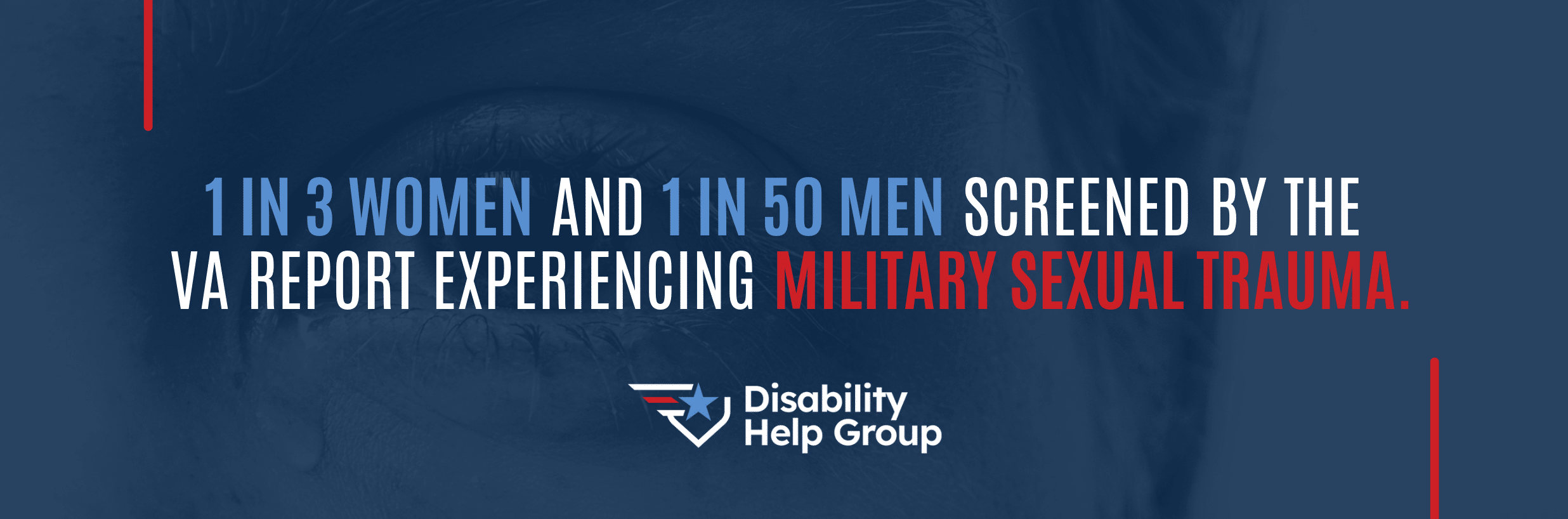
Post-traumatic stress disorder (PTSD) is a mental disability triggered by a traumatic event. When the average person thinks of a traumatic military event, they often think of combat. However, some military threats come from within our own ranks. Military Sexual Trauma, or MST, refers to experiences of sexual assault or sexual harassment during military service. As of 2025, approximately 1 in 3 women and 1 in 50 men report experiencing military sexual trauma (MST) when screened by their VA provider.
What Is Military Sexual Trauma (MST)?
Military Sexual Trauma includes any sexual activity where a service member is involved against his or her will. He or she may have been pressured into sexual activities (for example, with threats of negative consequences for refusing to be sexually cooperative or with implied better treatment in exchange for sex), or may have been physically forced into sexual activities.
Other MST experiences include unwanted sexual touching or grabbing; threatening, offensive remarks about a person’s body or sexual activities; and threatening and unwelcome sexual advances.
PTSD is the most common mental health diagnosis related to MST. You may be eligible for VA 100% if your PTSD is due to MST.
Service Connection PTSD due to MST
Before the VA will assign a 100% rating for PTSD due to MST, they must first determine whether it is related to service. In other words, VA must first grant service connection before it will assign a rating.
There are 4 requirements to prove service-connection PTSD due to MST:
Current diagnosis
In-service event, disease or injury
Medical nexus between the first 2 elements
Credible supporting evidence that the claimed in-service stressor occurred.
The challenge of Proving Military Sexual Trauma (MST)
Most victims are not eager to report MST to their superiors. This is especially true if a superior has committed the MST, the VA is well aware of this. Absent an official law enforcement record, how does one prove PTSD due to MST?
The VA looks for credible supporting evidence.
Credible supporting evidence of MST can include:
In-service pregnancy tests or tests for sexually transmitted diseases,
Statements from clergy, family members, and roommates
Evidence of behavior changes following the claimed assault.
Rating PTSD due to MST
After the VA grants service connection for PTSD due to MST, it must determine the correct rating. To do so, the VA consults the Schedule of Ratings.
The Schedule of Ratings breaks down disabilities into different categories. Each category contains groups of medical problems. For example, PTSD due to MST is found in the General Rating Formula for Mental Disorders. Depending on the symptoms, a veteran may receive either 0%, 10%, 30%, 50%, 70%, or 100%.
100% Rating: Total occupational and social impairment from PTSD due to MST
Gross impairment in thought processes or communication
Persistent delusions or hallucinations; grossly inappropriate behavior
The persistent danger of hurting self or others
Intermittent inability to perform activities of daily living (including maintenance of minimal personal hygiene)
Disorientation to time or place
Memory loss for names of close relatives, own occupation, or own name
70% Rating: Occupational and social impairment, with deficiencies in most areas, such as work, school, family relations, judgment, thinking, or mood
Suicidal ideation
Obsessional rituals which interfere with routine activities
Speech intermittently illogical, obscure, or irrelevant
Near-continuous panic or depression affecting the ability to function independently, appropriately, and effectively
Impaired impulse control (such as unprovoked irritability with periods of violence)
Spatial disorientation
Neglect of personal appearance and hygiene
Difficulty in adapting to stressful circumstances (including work or a work-like setting
Inability to establish and maintain effective relationships
50% Rating: Occupational and social impairment with reduced reliability and productivity
Flattened affect
Circumstantial, circumlocutory, or stereotyped speech
Panic attacks more than once a week
Difficulty in understanding complex commands
Impairment of short- and long-term memory (e.g., retention of only highly learned material, forgetting to complete tasks)
Impaired judgment
Impaired abstract thinking
Disturbances of motivation and mood
Difficulty in establishing and maintaining effective work and social relationships
30% Rating: Occupational and social impairment with occasional decrease in work efficiency and intermittent periods of inability to perform occupational tasks (although generally functioning satisfactorily, with routine behavior, self-care, and conversation normal)
Depressed mood
Anxiety
Suspiciousness
Panic attacks (weekly or less often), chronic sleep impairment, mild memory loss (such as forgetting names, directions, and recent events)
10% Occupational and social impairment due to mild or transient symptoms
Decrease work efficiency and ability to perform occupational tasks only during periods of significant stress
Symptoms controlled by continuous medication
0% Rating: A mental condition has been formally diagnosed
Symptoms are not severe enough either to interfere with occupational and social functioning
Require continuous medication
You May Be Entitled to VA 100% PTSD due to MST
The type, severity, and duration of a veteran’s symptoms will vary based on a number of factors. For example, race, religion, and sexual orientation can affect the impact of MST. Whether the MST happened once or was repeated over time may affect how long the symptoms last.
If your PTSD due to MST has caused any of the symptoms in the 100% range, then you may be entitled to a VA 100% disability rating.
Call Disability Help Group for a FREE Case Review! If you have more questions about getting a 100% rating for PTSD due to MST, please fill out our information form here or call us at (800) 800-3332. We offer a 100% guaranteed free case review. We will be happy to answer your questions.
If you or someone you know needs immediate support, help is available. The Veterans Crisis Line is free, confidential, and available 24/7 to veterans, service members, and their families.
Call the Veterans Crisis Line: Dial 988, then press 1
Cervical Neck Fusion and Social Security Disability
Cervical Neck Fusion and Social Security Disability. You may qualify for Social Security disability benefits if you’ve had a cervical neck fusion. However, you must show that you still can’t work. Many different problems can cause neck pain and other symptoms. Typically, degenerative disc disease, whiplash, herniated discs, and arthritis can cause ongoing symptoms. Neck impairments can cause many different symptoms.
These symptoms may include:
Pain
Limited movement of the neck or shoulders
Headaches
Shooting pain down the back or arms
Numbness and/or tingling
Getting Disability For Cervical Neck Fusion
You may qualify for Social Security disability benefits for your cervical neck fusion or impairments. However, you must show that your symptoms are severe. They must cause problems doing normal activities. Additionally, they must keep you from working for at least 12 months.
Social Security provides a listing of impairments, known as the “Blue Book.” The Blue Book provides specific conditions that you must meet to qualify for disability benefits. Social Security doesn’t have a specific listing for a cervical neck fusion. However, they do provide a listing for spinal disorders under 1.04.
To meet Social Security’s listing for your neck problems, you must show that the nerve root or spinal cord has been affected.
Additionally, you must show:
Evidence of nerve root compression, limited movement of your spine, and muscle weakness with loss of feeling or reflexes, or
Spinal arachnoiditis is a painful disorder caused by inflammation that causes you to have to change positions every two hours
Getting Disability If You Don’t Meet The Listing
Many people will not meet the listing for their cervical neck impairments. Fortunately, you can still get disability benefits. Specifically, you need to show that your neck problems limit your functioning and prevent you from working. Social Security assesses your residual functional capacity (RFC.)
Particularly, Social Security considers:
How long you can sit, stand, or walk at one time or in an 8-hour workday
How much weight you can lift or carry
Using your arms and hands for activities such as reaching, pushing, pulling, gripping, or grasping objects
If pain, fatigue, other symptoms, or side effects from medications cause limitations with concentration, persistence, or pace
Cervical Neck Fusion And Social Security Disability
Here’s an example of cervical neck fusion and SSD:
Anne injured her neck in a car accident. She required a cervical spinal fusion surgery. Despite surgery, she continued to have severe pain and difficulty moving her neck. She also still had problems using her hands due to numbness and tingling. Social Security determined that she could not lift or carry more than ten pounds but could sit for six hours. Additionally, Social Security found that she had serious problems using her hands throughout the day. Therefore, she was unable to do even simple seated jobs. As a result, Anne was approved for disability benefits.
Social Security Grid Rules
Social Security uses a chart called the Medical-Vocational Guidelines to evaluate your disability claim. These guidelines are known as the “grid rules”. The grid rules make it easier for older people to win their case. Social Security understands that it may be harder for older people to do new or different work. They will look at the grid rules if your impairments do not meet the conditions under the Social Security medical listings.
Cervical Neck Fusion And The Grid Rules
Here is an example of the grid rules for Cervical Neck Fusion:
Brad, a 57-year-old man previously worked as a janitor. He filed for disability because he developed degenerative disc disease in his neck. He had cervical spine surgery. Unfortunately, he continued to have pain in his neck. His doctor told him he couldn’t lift more than 10 pounds. Social Security found he couldn’t perform the duties required to be a janitor. Under the grid rules, Social Security approved Brad’s claim.
What Medical Evidence Is Needed For Cervical Neck Fusion And Neck Impairments?
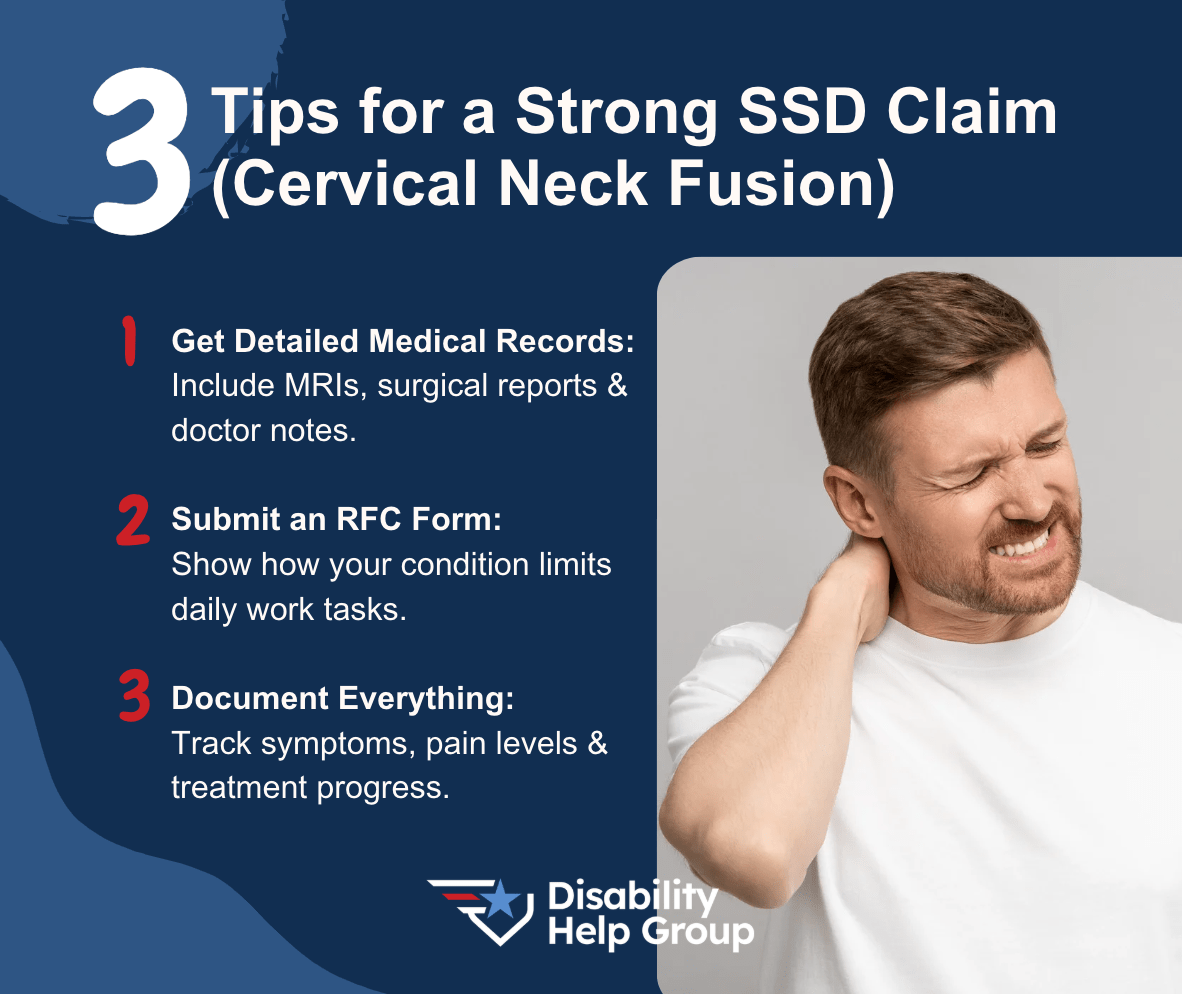
You must provide medical evidence to document any problems related to your neck problems. Generally, medical evidence includes your doctor’s treatment notes, test results, and imaging. Most importantly, you should have MRI evidence of your cervical spine.
Also, your doctor should document:
Any pain with movement of your bones or joints
Problems moving your neck
Problems using your hands
Difficulty traveling to places without assistance
Difficulty performing activities of daily living such as shopping, cooking, cleaning, using public transportation, bathing, or getting dressed
What Are RFC Forms?
An RFC form can clearly explain how your conditions impact your functioning. Having your doctor complete an RFC form can be very helpful. After all, they should know more about your health than anyone else. An RFC form should be very detailed. It should indicate all your medical symptoms and conditions. It should also include all of your treatment and any side effects from medications. An experienced disability advocate can provide these forms to you.
Disability Help Group Can Help You
Make sure you start your claim the right way and apply for all the benefits you deserve. If you have already applied for SSI or SSDI, call immediately to make sure your case is still pending and was filed correctly. You may be entitled to significant compensation. Contact us now for a free consultation.
What Conditions Qualify for Social Security Disability?
Many people considering applying for Social Security disability benefits have questions like, “What is considered a disability?” or “What conditions can I get Social Security disability for?” That’s not exactly how the Social Security Administration (SSA) analysis works.
While there is a detailed listing of impairments that may qualify a person for Social Security disability, you may also qualify with a condition that isn’t listed. Or, you may qualify with a combination of listed conditions, even though you don’t meet the criteria for either one separately.
What is Considered a Disability?
The SSA considers a person to be disabled if a medical condition or combination of medical conditions prevents them from engaging in substantial gainful activity (SGA) for at least 12 months.
The SSA defines SGA as the ability to earn a certain amount of money on a monthly basis. In 2025, that cut-off is $1,620/month.
Social Security’s Listing of Impairments
The listing of impairments, commonly referred to as the Blue Book, contains detailed listings in fourteen categories. They are:
Musculoskeletal Disorders
Musculoskeletal disorders are among the most common reasons people receive Social Security disability benefits, particularly back problems.
Of course, many people have back pain and other musculoskeletal conditions and are able to work. The SSA only considers you disabled if you can’t engage in SGA because of your medical condition. That’s determined in one of two ways. First, the SSA will look at the Blue Book listing for your condition, if there is one.
Spinal problems caused by compromise of a root nerve
Spinal problems caused by lumbar spinal stenosis
Abnormality of a major joint
Amputation
Soft tissue injury or abnormality
Some non-healing or complex fractures
If your condition isn’t listed or you don’t meet the criteria, the SSA will go on to evaluate whether there is work you can do with your medical limitations, based in part on factors like your age, educational level and past work experience.
If a person meets the SSA listing criteria for blindness, the SGA threshold is increased. In 2025, the SGA cut-off for a blind application is $2,700/month, compared with $1,620/month for other applicants.
As with other categories, it is important to remember that you may still qualify for Social Security disability benefits if your medical condition is not listed, or if you don’t meet the listing criteria for the condition.
Cardiovascular System
Any heart condition that prevents you from earning a living could qualify you for Social Security disability. Some cardiovascular conditions included in the Blue Book include:
Chronic heart failure
Ischemic heart disease
Recurrent arrhythmia
Symptomatic congenital heart disease
Heart transplant
Aortic aneurysm
Chronic venous insufficiency
Peripheral arterial disease
Digestive Disorders
Like other types of conditions, a digestive disorder may or may not qualify you for Social Security disability benefits, depending on the degree of limitation the condition causes. Conditions listed with specific criteria in the Blue Book include:
Gastrointestinal hemorrhaging
Chronic liver disease
Inflammatory bowel disease
Intestinal failure
Weight loss due to any medical condition
Transplant of the:
Liver
Small intestine
Pancreas
Genitourinary Disorders
While the category is much broader, the Blue Book listings for genitourinary disorders are focused on serious kidney-related conditions, including:
The SSA uses different criteria to evaluate chronic kidney disease depending on whether the condition requires dialysis, requires a transplant or involves impairment of kidney function.
Hemolytic anemias, including sickle cell disease and thalassemia
Disorders of thrombosis and hemostasis
Bone marrow failure
Hematological disorders treated by bone marrow or stem cell transplant
Repeated complications of hematological disorders
Skin Disorders
Most skin conditions won’t impair your ability to work, but when they do the SSA may approve Social Security disability benefits. Skin conditions listed with specific criteria for approval include:
Genetic photosensitivity conditions such as xeroderma pigmentosum
Burns
Chronic conditions of the skin or mucous membranes such as chronic skin lesions
Endocrine Disorders
Endocrine disorders cause hormonal imbalances, some of which can be debilitating. Endocrine conditions specifically addressed in the Blue Book include:
Pituitary gland disorders
Thyroid gland disorders
Parathyroid gland disorders
Adrenal gland disorders
Pancreatic gland disorders, including diabetes mellitus
Congenital Disorders Affecting Multiple Body Systems
The only condition the SSA evaluates under this set of criteria is non-mosaic Down Syndrome.
Neurological Disorders
The Blue Book contains listing and criteria for a wide range of neurological conditions, including:
Cancers treated by bone marrow or stem cell transplantation
Malignant melanoma
A few types of cancer are assessed under the category for the impacted organ or body system. An experienced Social Security disability benefits advocate can explain in greater detail how your particular type of cancer would be evaluated.
Immune System Disorders
Some immune disorders are evaluated under the body systems they impact, while others have criteria spelled out in this section of the Blue Book. These include:
Systemic lupus erythema (SLE)
Systemic vasculitis
Systemic sclerosis (scleroderma)
Polymyositis and dermatomyositis
Undifferentiated and mixed connective tissue disease
Get the Help You Need with Your Social Security Disability Claim
Whether your Social Security disability claim is evaluated under one of the many Social Security Blue Book listings or the more holistic approach, the process can be complicated. An experienced disability benefits advocate can help ensure that you have the right documentation to support your claim as fully as possible and give you the best chance of approval.
For help with an initial claim or a Social Security disability appeal, call 800-800-3332 right away or click here now.