
Highest Disability Approval Rates By State
If you’re applying for or considering applying for Social Security disability (SSD) benefits, you’ve probably heard that denial rates are high. You may also know that if you appeal, you can wait a long time for a hearing. What you may not know is that both approval rates and the wait time for an appeal hearing differ based on geography.
In other words, the chances of an initial SSD claim being approved are higher in some states than others. In fact, the rates can vary from office to office or even from Administrative Law Judge (ALJ) to ALJ within a state.
Understanding how your state compares can help you set expectations and better prepare your claim from the start.
SSD Initial Approval Rates by State (Most Recent Available Data)
Approval rates for initial SSD claims ranged from 34.8% in the lowest-approval state to 57.4% in the highest.
Just five states had initial SSD approval rates higher than 50%:
New Hampshire – 57.4%
North Dakota – 56%
Vermont – 54%
Nebraska – 52.7%
Rhode Island – 51.5%
Most states had initial SSD application approval rates between 40% and 50%. A handful fell below 40%, including:
Oklahoma – 39.7%
Florida – 39.6%
Georgia – 39.4%
Nevada – 38.8%
Tennessee – 38.3%
Arizona – 34.8%
Note: Social Security approval data is updated periodically by the SSA. Rates can change each year based on staffing, caseloads, and policy updates.
How Does Your State Stack Up?
The states with the highest and lowest approval rates for Social Security disability benefits are listed above, but what if you live in and are applying for disability benefits in one of the dozens of other U.S. states? Below are the most up-to-date approval rates per state.
| State | Approval Rate (%) | State | Approval Rate (%) |
|---|---|---|---|
| Alaska | 49.8 | Montana | 43.5 |
| Alabama | 42.5 | Nebraska | 52.7 |
| Arkansas | 43.9 | Nevada | 38.8 |
| Arizona | 34.8 | New Hampshire | 57.4 |
| California | 42.5 | New Jersey | 43.3 |
| Colorado | 41.0 | New Mexico | 46.2 |
| Connecticut | 49.2 | New York | 44.8 |
| Delaware | 44.7 | North Carolina | 40.8 |
| District of Columbia | 45.8 | North Dakota | 56.0 |
| Florida | 39.6 | Ohio | 44.1 |
| Georgia | 39.4 | Oklahoma | 39.7 |
| Hawaii | 41.5 | Oregon | 47.9 |
| Idaho | 41.8 | Pennsylvania | 46.4 |
| Illinois | 46.3 | Puerto Rico | 46.1 |
| Indiana | 49.8 | Rhonde Island | 51.5 |
| Iowa | 48.7 | South Carolina | 45.5 |
| Kansas | 48.4 | South Dakota | 45.3 |
| Kentucky | 40.6 | Tennessee | 38.3 |
| Louisiana | 45.9 | Texas | 43.5 |
| Maine | 46.4 | Utah | 45.1 |
| Maryland | 47.2 | Vermont | 54.0 |
| Massachusetts | 45.3 | Virginia | 48.9 |
| Michigan | 48.6 | Washington | 45.9 |
| Minnesota | 48.2 | West Virginia | 41.7 |
| Mississippi | 46.7 | Wisconsin | 49.8 |
| Missouri | 47.5 | Wyoming | 47.3 |
Why are State SSD Approval Rates So Different?
It may surprise you that approval rates vary so much from state to state, given that Social Security disability is a federal program with a consistent set of requirements and eligibility criteria. There are several factors that may play a role in the SSD approval rate in a given state. It’s also worth noting that state populations vary significantly, meaning that the sample sizes are much different.
For example, in Alaska, only a few hundred claims may be decided in a quarter. In California, that number can exceed 16,000. Larger sample sizes tend to create more stable trends, while smaller states may see bigger swings.
Other factors that may affect approval rates include:
- How strictly applications are reviewed locally
- Staffing levels at Disability Determination Services (DDS) offices
- Access to quality healthcare and medical documentation
- Average age of the population
- Education and work history patterns
- Whether applicants receive professional help with their claim
Even small differences in documentation or wording can make or break a case.
What You Can Control to Improve Your SSD Approval Odds
While you can’t change where you live, you can take steps to strengthen your application.
Helpful tips include:
- Regularly see your doctor and specialists
- Follow prescribed treatment plans
- Keep detailed records of symptoms and limitations
- Submit complete medical evidence
- Respond quickly to SSA requests
- Be honest and consistent on forms
- Get professional help if you’re unsure
Many denials happen simply because paperwork is incomplete or key medical evidence is missing, not because the person isn’t disabled.
The availability of quality assistance with the application process, which can make a significant difference in approval rates because an experienced advocate can ensure that the applicant avoids common mistakes and knows what type of documentation the Social Security Administration (SSA) will be looking for.
While it may be useful to know what to expect in terms of the likelihood of approval at the initial application stage in your state, it’s more important to focus on the factors that are within your control.
Why Working With an Advocate Matters
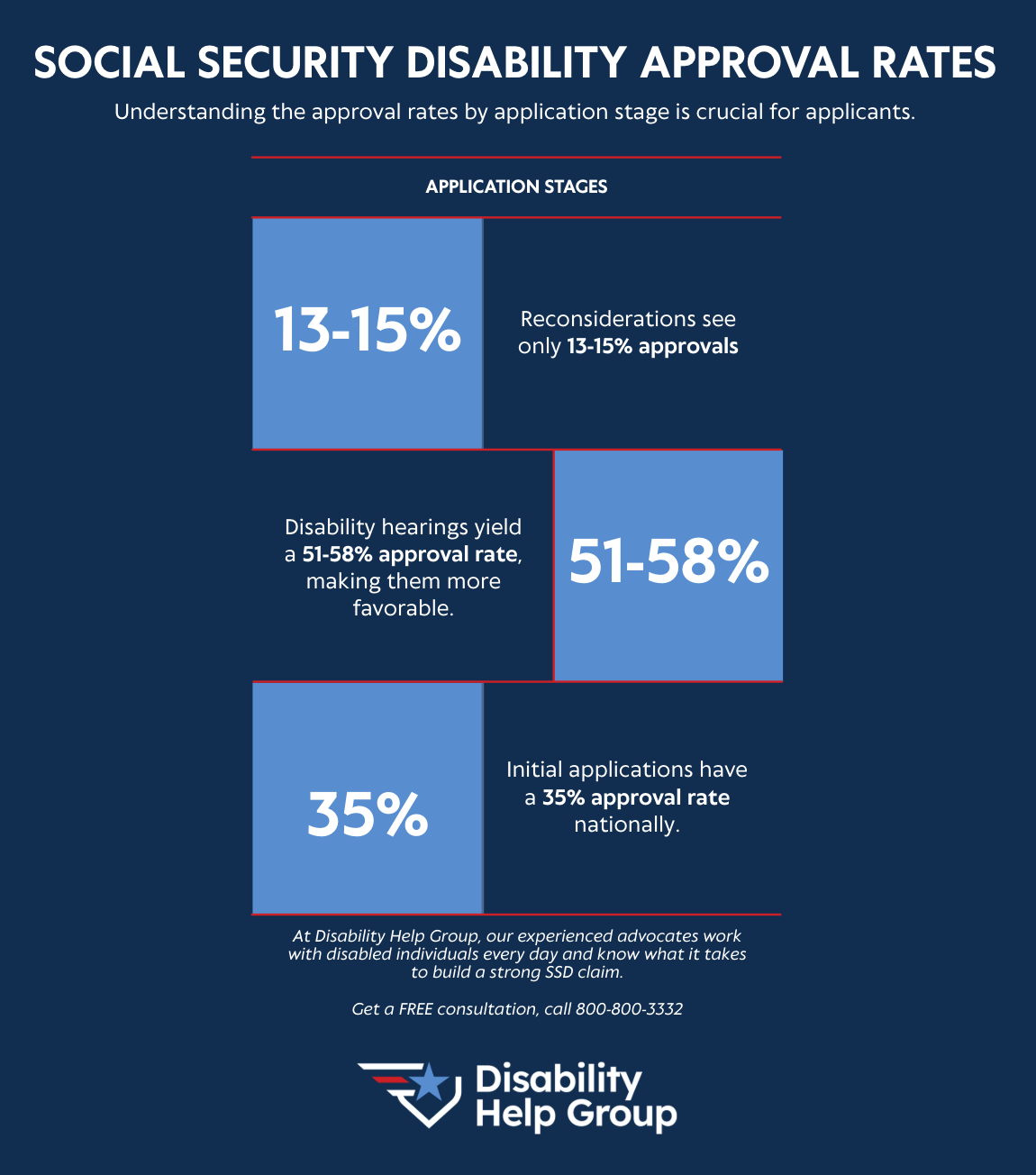
Statistically, more than half of initial SSD claims are denied nationwide. But many of those denials could have been prevented with stronger documentation or clearer explanations of how a condition limits daily function.
An experienced advocate understands exactly what the Social Security Administration looks for and can help you avoid common mistakes, strengthen medical evidence, and present your case clearly.
At Disability Help Group, our team works with disabled individuals across the country every day to file new applications, requests for reconsideration, and appeals. We know how to build claims that give you the best possible chance of approval.
To learn more about how we can help, call 800-800-3332 or request your free case evaluation through our contact form HERE.
Frequently Asked Questions (FAQ)
What state has the highest SSD approval rate?
Historically, smaller states like New Hampshire, North Dakota, and Vermont often report higher initial approval rates. However, rates change yearly.
What state has the lowest SSD approval rate?
Some larger or high-volume states tend to have lower approval percentages, often due to heavy caseloads. Arizona and several southern states have historically reported lower rates.
Does moving to another state improve my chances?
No. Moving solely for approval odds usually isn’t practical and won’t guarantee success. Strong medical evidence matters far more than geography.
How long does SSD approval take?
Initial decisions typically take 3–6 months. Appeals and hearings can take longer depending on backlog and location.
Are SSD appeals more successful than initial claims?
Yes. Many applicants are approved during reconsideration or at a hearing with an Administrative Law Judge.
Should I get help with my SSD application?
Yes. Professional assistance can significantly reduce mistakes, strengthen your evidence, and improve your overall chances of approval.