If you’ve received an “appeal under review” status from the Social Security Administration (SSA), it can be confusing. This update in the Social Security Disability (SSDI) appeals process indicates that a decision has been made on your claim, but it does not reveal the outcome.
Many applicants worry that this status is negative or wonder what actions they should take next. Understanding what “appeal under review” means, and what it doesn’t mean, can help you stay informed and reduce unnecessary stress.
Understanding the “Appeal Under Review” Status
When you see “appeal under review,” it simply means the SSA has assigned someone to review specific parts of your SSDI claim. This step is routine and part of the appeals process.
A medical or administrative review has been completed.
The SSA is evaluating the results.
No decision is communicated until the review is complete.
This status is not inherently negative. It does not imply denial or approval. It’s simply an indication that the review process is underway.
Key takeaway: Until the review is finished, there’s generally nothing you need to do except monitor updates. Once your claim is approved, you will be notified. If it’s denied, you will have options to continue the appeals process.
The SSDI Appeals Process: What Comes Next
Understanding the multi-step SSDI appeals process can help you plan your next steps if you receive a denial. Here’s the typical path:
Reconsideration – The SSA reviews the claim again, taking into account additional evidence.
Hearing Before an Administrative Law Judge (ALJ) – If reconsideration is denied, you can request a hearing with an ALJ.
Appeals Council Review – Optional: The Appeals Council may review your case and issue a decision.
Federal District Court – The final step, usually requiring legal representation.
Even if your claim is denied at one stage, you still have opportunities to appeal and potentially secure benefits. Knowledge of the process and deadlines is critical.
Tips While Waiting for Your Appeal Review
While it may feel like waiting is the hardest part, there are steps you can take to stay proactive:
Document any changes in your condition – New symptoms or worsening conditions may strengthen your appeal.
Stay in contact with your advocate – Experienced disability advocates can help monitor your claim, gather documentation, and advise on next steps.
Avoid unnecessary follow-ups with SSA – Excessive calls may slow the process or create confusion; rely on your advocate for updates.
Get help from a top-ranked disability advocate, call 800-800-3332 or contact us online HERE!
What if the Appeal is Denied?
The appeals process is a multi-step one, so if you receive a denial after the review is complete, you still have options. The hearing before the administrative law judge (ALJ) is one of the last steps in the process, but it’s not the end of the road. The next step is to request a review by the Appeals Council. Unlike the other steps in the process, there’s no right to this review–the Appeals Council decides whether or not to take up the case.
If they pass or rule against you, the final step is the federal district court. That is a much more complex process that is best attempted with the help of an experienced disability lawyer.
Real-Life Example: Understanding the Timeline
Consider John, an SSDI applicant:
John’s claim was initially denied.
After submitting additional medical records, he received “appeal under review” in the portal.
Four months later, the SSA approved his claim, and John received back pay for the months he was waiting.
This example illustrates that “appeal under review” is not a negative outcome; it simply signals that the SSA is completing its review process.
Ensure your application is thorough and well-documented.
Reduce delays by anticipating SSA requirements.
Increase your chances of approval on the first submission or during appeals.
At Disability Help Group, we assist applicants at every stage, from initial application to Appeals Council review. Our experienced advocates can:
Prepare strong applications with complete documentation
Guide you through the appeals process efficiently
Monitor deadlines to avoid missed opportunities
Represent your interests in hearings and communications with SSA
Call us at 800-800-3332 or contact us HERE to learn how we can help with your SSDI claim. The earlier you get professional support, the stronger your case will be.
FAQs About “Appeal Under Review”
How long does the SSA take to complete the review?
Processing times vary depending on the complexity of your case, but reviews typically take several weeks to a few months. Complex cases or those requiring additional medical records may take longer.
Does “appeal under review” affect my back pay?
No. Back pay is only affected by the final approval date of your claim. Whether the review takes a few weeks or months, it does not reduce the benefits you may be entitled to once approved.
Can I submit new evidence during the review?
It depends on your case stage. Generally, you can submit additional medical evidence or documentation before the ALJ hearing, but not after the review is already underway. Consulting with a disability advocate can clarify your options.
How Long Does it Take to Get Social Security Disability Benefits?
According to the Social Security Administration (SSA), the average processing time for a new Social Security Disability (SSDI) application is three to six months. But, the average processing time varies from state to state. And, that estimate can be a bit misleading. That’s the average time SSA says you should expect to wait for an initial determination. But, a significant percentage of applications are denied at this stage. Working your way through the process of reconsideration and appeals can take much longer.
Fortunately, there are some things you can do to speed up the initial application process and increase your chances of being approved earlier in the process.
Expediting Your SSDI Application
SSA doesn’t offer an expedited process for disability benefits, but you can take steps to make the process as efficient as possible. First, SSA says you can cut your processing time in half if you apply online.
Ensuring that your SSDI application is complete, you’ve provided all necessary documentation, and your medical providers promptly share necessary information can also help move the process forward. A Social Security Disability Benefits Advocate can be your best source of assistance in putting together a clear and complete application to give you the best chance of approval.
The Social Security Administration does have limited “Compassionate Allowances” and “Quick Disability Determinations” programs for certain severe conditions:
Compassionate Allowances (CAL)
The SSA identifies claims where the applicant’s disease or condition clearly meets Social Security’s statutory standard for disability. The Compassionate Allowances program allows Social Security to target the most obviously disabled individuals for allowances based on objective medical information that can be obtained quickly. Compassionate Allowances reduce wait time to reach a disability determination for individuals with the most serious disabilities.
Conditions that qualify for Compassionate Allowances include certain cancers, adult brain disorders, and rare disorders affecting children. There are currently over 200 conditions in the Compassionate Allowances program.
Quick Disability Determinations (QDD)
The Quick Disability Determinations (QDD) process uses a computer-based predictive model to identify claims where a favorable disability determination is highly likely and where evidence is readily available. This allows SSA to make these decisions faster while maintaining accuracy.
Ways to Speed Up Your Application Process
Apply online – Online applications can be processed more quickly
Provide complete information – Include all requested information on your application
Submit medical evidence promptly – Provide names, addresses, and phone numbers of all doctors, hospitals, and clinics that have treated you
Respond quickly to SSA requests – If SSA contacts you for additional information, respond as soon as possible
Report changes – Inform SSA immediately if your condition worsens or if you see new doctors
What if the Initial SSDI Application is Denied?
If your initial SSDI application is denied, the next step in most states is a request for reconsideration. This step is usually quicker than the initial application, but the success rate is low. The highest rate of approval occurs at the next stage: a hearing before an administrative law judge (ALJ). However, it can take more than a year to get a hearing before an ALJ, and then several months to receive your determination. Those who are denied at this stage may require an additional step, or even two, to complete the process.
In short, a claim for Social Security disability benefits (SSDI) may be approved in just a few months, and you may begin receiving benefits as soon as six months after you become disabled. But most SSDI application claims are denied in the initial rounds, meaning that many who apply for disability benefits don’t start receiving benefits for two years or more. If you disagree with the initial determination by the SSA, you have the right to appeal.
The Four Levels of Appeal
Reconsideration – A complete review of your claim by someone who did not take part in the first determination. You generally have 60 days from the date you receive the notice of the decision to ask for a reconsideration.
Hearing by an Administrative Law Judge (ALJ) – If you disagree with the reconsideration decision, you may request a hearing before an ALJ. The ALJ will review your case and consider any new evidence. You generally have 60 days from the date you receive the reconsideration notice to request a hearing.
Review by the Appeals Council – If you disagree with the ALJ’s decision, you may request a review by Social Security’s Appeals Council. The Appeals Council looks at all requests for review, but it may deny a request if it believes the ALJ’s decision was correct. You generally have 60 days to request Appeals Council review.
Federal Court Review – If you disagree with the Appeals Council’s decision or if the Appeals Council decides not to review your case, you may file a lawsuit in a federal district court. You generally have 60 days to file a civil suit after you receive notice of the Appeals Council’s action.
Current Processing Times for Appeals
The average wait time for a hearing before an Administrative Law Judge has historically ranged from 12 to 18 months or more, depending on the hearing office location and current case backlog. After the hearing, it typically takes several additional months to receive a written decision.
The SSA has been working to reduce wait times through various initiatives including:
Hiring additional Administrative Law Judges
Implementing technology improvements
Expanding video hearing capabilities
Streamlining case processing procedures
A Social Security Disability Advocate Can Help
Your best chance of receiving Social Security disability benefits (SSDI) as quickly as possible is to ensure that you avoid missteps in the process, don’t miss any appeal deadlines, and provide complete documentation to the SSA in a format that is easy to work with.
The process can be daunting. At Disability Help Group, we understand the process, and we understand the stress you’re under and how important it is for you to receive your disability benefits. To learn more about how we can help, call (800) 800-2009 or contact us right now.
A disability advocate can help you by:
Ensuring your initial SSDI application is complete and includes all necessary medical evidence
Helping you obtain supporting documentation from your doctors
Preparing you for consultative examinations
Representing you at your ALJ hearing
Presenting your case effectively with proper legal and medical arguments
Meeting all critical deadlines throughout the appeals process
Communicating with SSA on your behalf
Frequently Asked Questions About SSDI Processing Times
Can I work while my SSDI claim is being processed? Working while your claim is pending can be complicated. If you earn more than the Substantial Gainful Activity (SGA) amount ($1,550/month for non-blind individuals in 2025), it may affect your eligibility. Consult with a disability advocate before making employment decisions during the application process.
What happens if my condition worsens while waiting for a decision? You should immediately notify SSA if your condition worsens or if you develop additional disabling conditions. Submit updated medical records and ask your doctors to provide current assessments of your limitations.
Will I be notified of the decision by mail? Yes, SSA will send you a written notice of their decision. If approved, the notice will explain your benefit amount and when payments will begin. If denied, it will explain the reasons and your appeal rights.
Can I check the status of my application online? Yes, you can check your application status online by creating a my Social Security account at https://www.ssa.gov/myaccount/. You can also call SSA at 1-800-772-1213 to check your status.
Widows benefits and Social Security disability benefits are both monthly federal benefits administered by the Social Security Administration (SSA) and based on work credits accrued. However, there are significant differences between the two. First, widows benefits are based on the deceased spouse’s work record, not the recipient’s.
Second, disability benefits can be awarded at any age, but are only available to workers who meet the SSA’s definition of “disabled.” Widows benefits, with certain exceptions, are only available to people who have reached a certain age.
Widows benefits are a type of survivor benefits. Though you may hear these terms used interchangeably with “death benefits.” Social Security does offer a death benefit, but it is a small, one-time payment that is separate from these monthly benefits.
Widows Benefits
Widows benefits, technically known as survivors’ benefits, are available to certain dependents of a deceased worker who earned Social Security benefits. The widow or widower of a qualified worker is entitled to Social Security survivors’ benefits if certain qualifications are met:
Widows Benefits Age Requirements
In most circumstances, the surviving spouse of a deceased worker may receive widows’ benefits only if:
The surviving spouse has reached full retirement age (reduced benefits are available at age 60), or
The surviving spouse is at least 50 and has a disability
The age requirements above do not apply if:
The surviving spouse is caring for a child or children of the deceased who are under the age of 16 and receiving Social Security benefits, or
The surviving spouse is caring for a child of the deceased who is disabled and receiving Social Security benefits
Other Social Security Rules for Widows
A divorced spouse of a deceased worker may qualify for benefits under the same conditions if the marriage lasted at least 10 years. The 10-year requirement is not imposed if the former spouse is caring for children of the deceased as described above. However, remarriage may disqualify a former spouse from survivor benefits. Generally, a former spouse who remarries after turning 60 remains eligible.
However, a former spouse who remarries younger may or may not be eligible for Social Security benefits, depending on:
The type of benefits in question
Whether the former spouse is disabled
Whether the former spouse remarried before age 50
Whether the later marriage has ended
An experienced Social Security benefits advocate can help you determine which types of benefits you may be entitled to in your specific circumstances.
Social Security Disability Benefits
SSDI benefits are payable to qualified workers who are unable to engage in substantial gainful activity due to a disability that is expected to last at least one year or be fatal. To qualify for SSDI, you must have accumulated a sufficient number of work credits, including a certain number of recent credits. The exact number depends on your age when you became disabled.
SSDI Widow Eligibility Requirements
Unlike retirement benefits and survivor benefits, SSDI benefits are awarded only on your own work record. That means Social Security disability eligibility requirements for a widow are the same as they would be for anyone else.
The applicant must meet technical requirements, such as having accrued sufficient work credits to qualify for disability benefits. And, they must meet the SSA’s definition of disability based on a condition or conditions that have lasted or are expected to last for at least 12 months. There are multiple steps in the disability determination process. First, the SSA will look to see whether the person is earning enough money to be considered engaged in substantial gainful activity. Note, though, that survivor benefits do not count toward SSDI income limits. The SSA will be looking only at income earned through work or self-employment.
If they are not, the next step is to consider whether they meet or equal a listing in the Social Security blue book. If they do not, the SSA uses a more holistic analysis to determine whether they might still be considered disabled.
Can You Get Both SSDI and Widows Benefits?
You may qualify for both disability benefits and widows benefits. But, you can’t get the full amount of both benefits. Instead, your monthly benefit will be capped at the higher of the two amounts. Here’s an example of how that might play out.
SSDI and the Death of a Spouse
Imagine that you are receiving $1,350/month in Social Security disability benefits when your spouse passes away. Since you are disabled, you become qualified for survivor benefits if you are at least 50 years old. You may also qualify if you are younger than 50 but caring for your deceased spouse’s child.
Say you qualify for $1,900/month in survivor benefits. You won’t receive the full amount of each benefit, and the survivor benefits won’t replace the lower SSDI benefit.. Instead, you will continue to receive your $1,350 in disability benefits and will receive an additional $550/month in widows benefits to bring you up to the amount of the higher benefit.
Need Help Getting Social Security Disability Benefits?
SSDI benefits provide a crucial source of support for workers who become disabled. But, unfortunately, most claims are initially denied. Too often, applicants get discouraged and miss out on benefits they’ve earned through years of hard work and paying in premiums through payroll taxes.
At Disability Help Group, we have deep knowledge of the rules that govern the SSDI application process and the type of evidence necessary to submit the strongest possible application. Working with an experienced disability benefits advocate from the beginning can help avoid common missteps that can delay your claim or lead to denial.
If you’ve already applied and been denied, we can still help. Our advocates will assess the denial letter you received and other information to determine what went wrong and what additional information or documentation will most strengthen your case on appeal. To learn more, contact us here or call (800) 800-3332.
Can I get A 100% VA Rating for PTSD due to Military Sexual Trauma?
Post Traumatic Stress Disorder (PTSD)
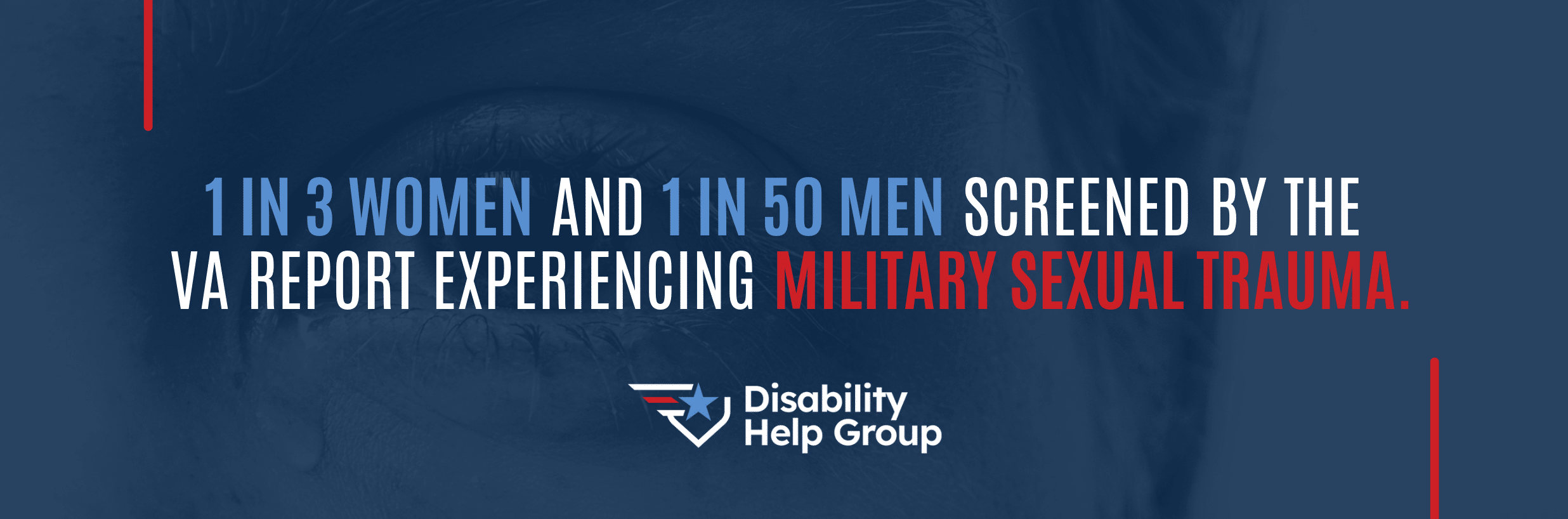
Post-traumatic stress disorder (PTSD) is a mental disability triggered by a traumatic event. When the average person thinks of a traumatic military event, they often think of combat. However, some military threats come from within our own ranks. Military Sexual Trauma, or MST, refers to experiences of sexual assault or sexual harassment during military service. As of 2025, approximately 1 in 3 women and 1 in 50 men report experiencing military sexual trauma (MST) when screened by their VA provider.
What Is Military Sexual Trauma (MST)?
Military Sexual Trauma includes any sexual activity where a service member is involved against his or her will. He or she may have been pressured into sexual activities (for example, with threats of negative consequences for refusing to be sexually cooperative or with implied better treatment in exchange for sex), or may have been physically forced into sexual activities.
Other MST experiences include unwanted sexual touching or grabbing; threatening, offensive remarks about a person’s body or sexual activities; and threatening and unwelcome sexual advances.
PTSD is the most common mental health diagnosis related to MST. You may be eligible for VA 100% if your PTSD is due to MST.
Service Connection PTSD due to MST
Before the VA will assign a 100% rating for PTSD due to MST, they must first determine whether it is related to service. In other words, VA must first grant service connection before it will assign a rating.
There are 4 requirements to prove service-connection PTSD due to MST:
Current diagnosis
In-service event, disease or injury
Medical nexus between the first 2 elements
Credible supporting evidence that the claimed in-service stressor occurred.
The challenge of Proving Military Sexual Trauma (MST)
Most victims are not eager to report MST to their superiors. This is especially true if a superior has committed the MST, the VA is well aware of this. Absent an official law enforcement record, how does one prove PTSD due to MST?
The VA looks for credible supporting evidence.
Credible supporting evidence of MST can include:
In-service pregnancy tests or tests for sexually transmitted diseases,
Statements from clergy, family members, and roommates
Evidence of behavior changes following the claimed assault.
Rating PTSD due to MST
After the VA grants service connection for PTSD due to MST, it must determine the correct rating. To do so, the VA consults the Schedule of Ratings.
The Schedule of Ratings breaks down disabilities into different categories. Each category contains groups of medical problems. For example, PTSD due to MST is found in the General Rating Formula for Mental Disorders. Depending on the symptoms, a veteran may receive either 0%, 10%, 30%, 50%, 70%, or 100%.
100% Rating: Total occupational and social impairment from PTSD due to MST
Gross impairment in thought processes or communication
Persistent delusions or hallucinations; grossly inappropriate behavior
The persistent danger of hurting self or others
Intermittent inability to perform activities of daily living (including maintenance of minimal personal hygiene)
Disorientation to time or place
Memory loss for names of close relatives, own occupation, or own name
70% Rating: Occupational and social impairment, with deficiencies in most areas, such as work, school, family relations, judgment, thinking, or mood
Suicidal ideation
Obsessional rituals which interfere with routine activities
Speech intermittently illogical, obscure, or irrelevant
Near-continuous panic or depression affecting the ability to function independently, appropriately, and effectively
Impaired impulse control (such as unprovoked irritability with periods of violence)
Spatial disorientation
Neglect of personal appearance and hygiene
Difficulty in adapting to stressful circumstances (including work or a work-like setting
Inability to establish and maintain effective relationships
50% Rating: Occupational and social impairment with reduced reliability and productivity
Flattened affect
Circumstantial, circumlocutory, or stereotyped speech
Panic attacks more than once a week
Difficulty in understanding complex commands
Impairment of short- and long-term memory (e.g., retention of only highly learned material, forgetting to complete tasks)
Impaired judgment
Impaired abstract thinking
Disturbances of motivation and mood
Difficulty in establishing and maintaining effective work and social relationships
30% Rating: Occupational and social impairment with occasional decrease in work efficiency and intermittent periods of inability to perform occupational tasks (although generally functioning satisfactorily, with routine behavior, self-care, and conversation normal)
Depressed mood
Anxiety
Suspiciousness
Panic attacks (weekly or less often), chronic sleep impairment, mild memory loss (such as forgetting names, directions, and recent events)
10% Occupational and social impairment due to mild or transient symptoms
Decrease work efficiency and ability to perform occupational tasks only during periods of significant stress
Symptoms controlled by continuous medication
0% Rating: A mental condition has been formally diagnosed
Symptoms are not severe enough either to interfere with occupational and social functioning
Require continuous medication
You May Be Entitled to VA 100% PTSD due to MST
The type, severity, and duration of a veteran’s symptoms will vary based on a number of factors. For example, race, religion, and sexual orientation can affect the impact of MST. Whether the MST happened once or was repeated over time may affect how long the symptoms last.
If your PTSD due to MST has caused any of the symptoms in the 100% range, then you may be entitled to a VA 100% disability rating.
Call Disability Help Group for a FREE Case Review! If you have more questions about getting a 100% rating for PTSD due to MST, please fill out our information form here or call us at (800) 800-3332. We offer a 100% guaranteed free case review. We will be happy to answer your questions.
If you or someone you know needs immediate support, help is available. The Veterans Crisis Line is free, confidential, and available 24/7 to veterans, service members, and their families.
Call the Veterans Crisis Line: Dial 988, then press 1
If you suffer from a disability and live in the U.S. you may be entitled to Social Security Disability benefits. For this to happen the Social Security Administration must deem your disability severe enough that you cannot engage in “Substantial Gainful Activity”
The SSA evaluates your medical condition by looking at the “Listing of Impairments” and assessing your work-related limitations. The “Listings” outline each major body system, and provide requirements necessary for proving disability. Many of the listed impairments are permanent or likely to result in death.
For all other conditions, the SSA assesses your medical evidence which must demonstrate that your disorder will last at least 12 months and prevent you from working at any job.
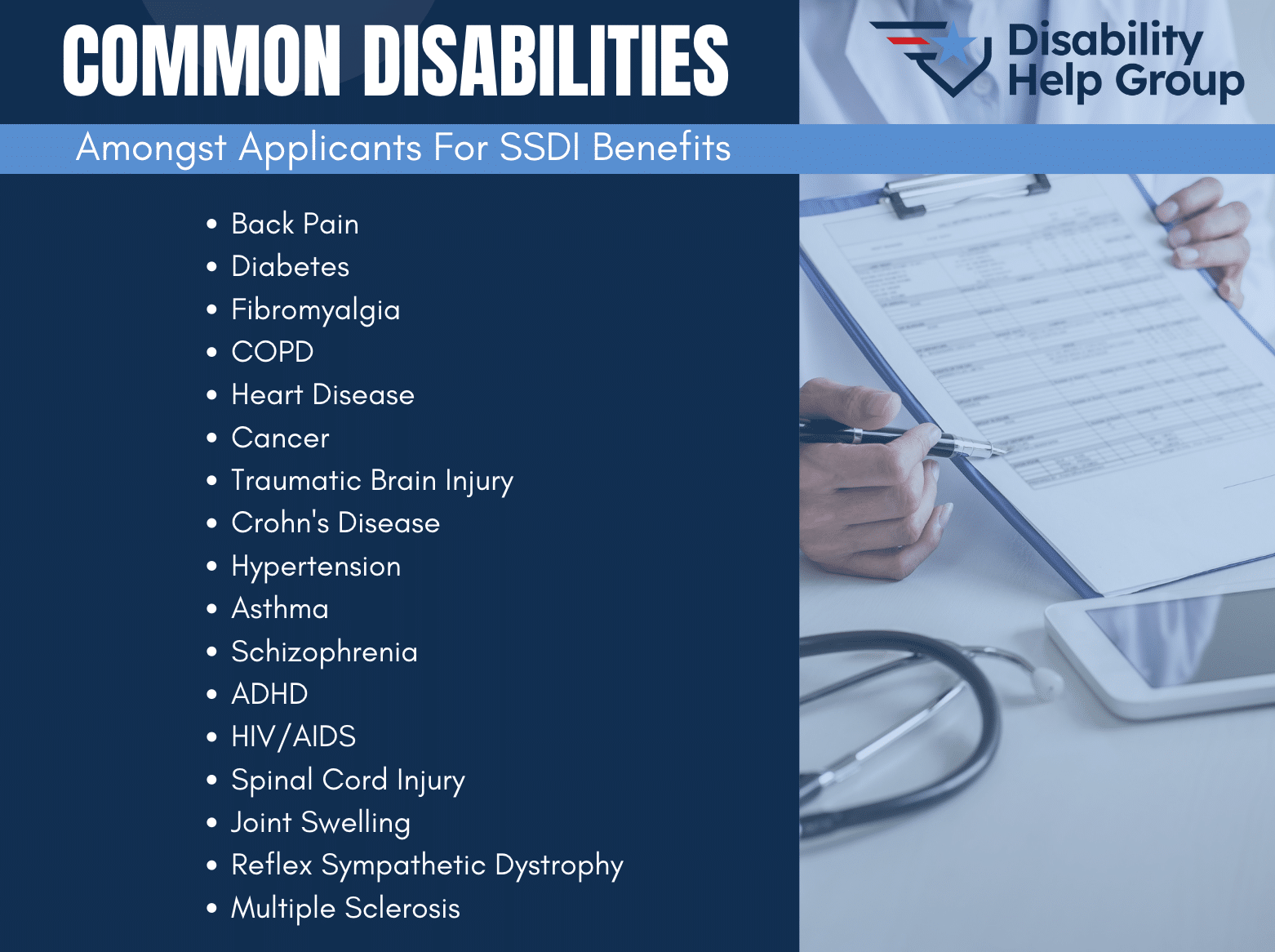
What Are The Most Common Disabilities?
The list below will show you the type of medical conditions/disabilites that are the most common among SSD benefit applicants. (This list is based on the SSA’s Blue Book.)
Cancer
Cardiovascular Systems
Congenital Disorders That Affect Multiple Body Systems
Digestive System
Endocrine System Disorders
Hematological Disorders
Genitourinary Disorders
Immune System Disorders
Mental Disorders
Musculoskeletal System
Neurological Disorders
Respiratory Disorders
Skin Disorders
Special Senses and Speech
Get The Help You Need To Secure SSD Benefits
At Disability Help Group, we work hard to build a strong medical file to support your SSD claim. We will request your medical records and medical evaluations from your doctors and give you the best chance of receiving the benefits you deserve. Contact our team of experts today here or call us at 800-800-3332.
Sleep is required to function. Sleep Apnea is a condition where someone briefly and repeatedly stops and starts breathing. This can severely disrupt someone’s sleeping patterns affecting their mental, emotional, and physical health.
Service Connection
For the VA to assign a 100% rating for Sleep Apnea, the VA must first determine that the condition is related to service.
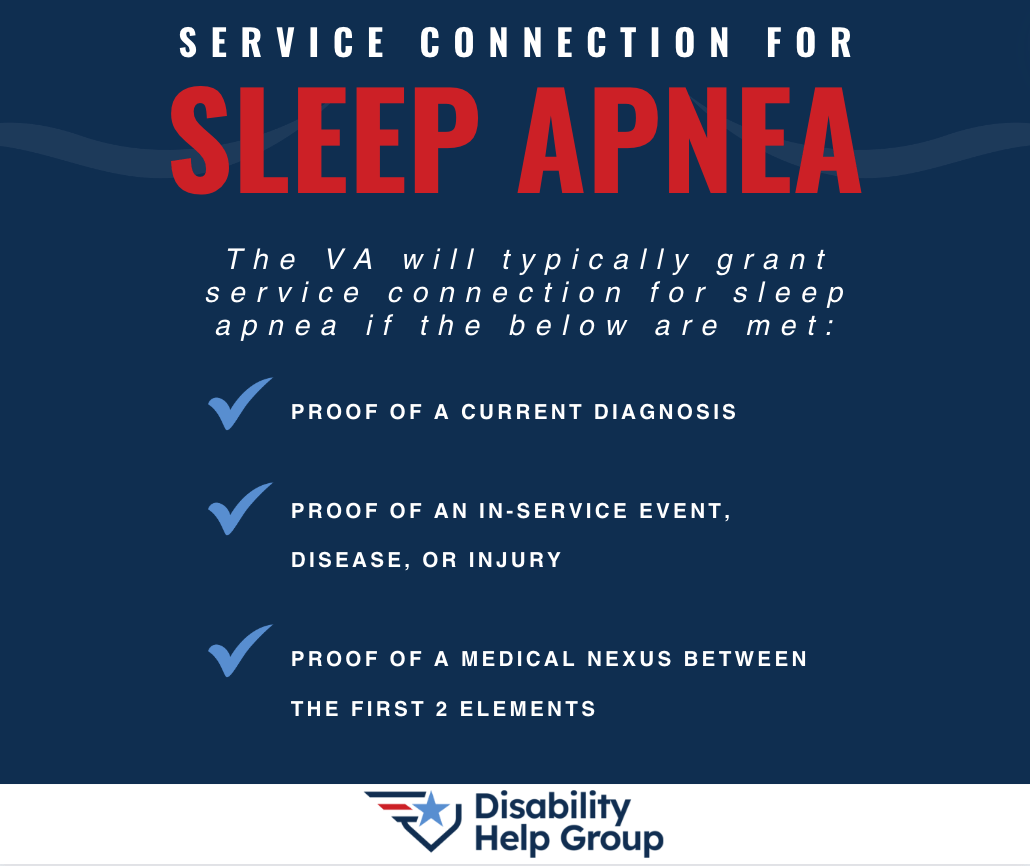
Generally, VA will grant service connection if the following are met:
Proof of a current diagnosis,
Proof of an in-service event, disease, or injury, and
Proof of a medical nexus between the first 2
elements.
VA Schedule of Rating
After the VA grants service connection, it must determine the correct rating. To do so, VA consults the Schedule of Ratings. The ratings should reflect how much that specific disability impairs your ability to work.
To get a 100% rating for sleep apnea, it must be so severe that it prevents gainful employment.
Requirements Specific to Sleep Apnea
The Schedule of Ratings breaks down disabilities into different categories. Each category contains groups of medical problems. For example, Sleep Apnea is found in the Respiratory System category. Each group contains a list of disabilities, each with its own diagnostic code. In turn, each diagnostic code specifies the symptoms required for various ratings. For example, the 6847 code applies to Sleep Apnea. See 38 C.F.R. § 4.97.
A 100% VA rating for Sleep Apnea requires:
Chronic respiratory failure with carbon dioxide
retention or cor pulmonale, or
The condition requires a tracheostomy.
Chronic Respiratory Failure
Chronic respiratory failure usually happens when the airways that carry air to your lungs become narrow and damaged. In other words, less oxygen gets in and less carbon dioxide goes out. A tracheostomy is a surgically made hole in the front of your neck where a breathing tube is connected to your windpipe to help you breathe. Naturally, a veteran with these extreme symptoms deserves a 100% VA rating for Sleep Apnea.
Medical Evidence
Only medical evidence can satisfy these requirements. It is not enough for the veteran to say “I cannot work because of my sleep apnea.” Fortunately, the VA provides rating tools such as Disability Benefits Questionnaires (“DBQs”) on their website. Specifically, VA provides a Sleep Apnea DBQ that focuses on the symptoms described in the Schedule. Veterans seeking a higher rating for sleep apnea should have their doctors complete the DBQ. The VA will likely grant the rating if the DBQ includes the criteria for a 100% rating for Sleep Apnea.
Disability Benefits Questionnaire
A doctor who treats the disability in question should fill out a Disability Benefits Questionnaire. For example, an orthopedic specialist who is treating a foot condition should not complete a DBQ for PTSD.
Watch out for Pyramiding
When seeking a 100% rating for Sleep Apnea, one must consider every rule and exception related to VA ratings. Under the VA rating system, a veteran should be compensated for each service-connected disability. However, there is one big exception. VA cannot pay a veteran more than once for the same disability or same manifestation. For example, Asthma and Sleep Apnea have nearly identical manifestations. They both involve airway impairment, share symptoms such as daytime fatigue and are under the same category in the Schedule of Ratings. A veteran who is service connected for both will only receive a rating for one of them. In that circumstance, the VA must assign the higher of the 2 possible ratings.
How We Can Help
Many variables come into play when trying to get 100% VA disability for Sleep Apnea. The first step is to not give up. Our team of experts are here to support you the entire way through. Whether you are struggling to secure your VA disability or need help with your denied SSD claims, we’re only a phone call away. To learn more about how our team can help you call us today at (800) 800-3332 or contact us here now for a FREE consultation.