

What Can You Own On Social Security Disability?
“Social Security disability” technically refers to the SSDI (or SSD) program. However, people often interchangeably use the term to refer to SSD and Supplemental Security Income (SSI). While both programs are administered by the Social Security Administration (SSA), they are very different. SSD is funded by FICA contributions deducted from your paycheck. SSI, on the other hand, is a need-based program funded by the Treasury.
Since SSI is need-based and SSD is based on your work history and past contributions, eligibility requirements are very different. In particular, the income and assets allowed on Social Security disability far exceed those permitted on SSI.
What Can You Own on SSDI?
To qualify for SSDI benefits, you must have earned a certain number of work credits over your career and a smaller number in the 10 years before you became disabled. In 2026, you earn one work credit for every $1,890 in covered earnings, up to four credits per year ($7,560 total). How many credits you need depends on your age when you became disabled, someone disabled at 27 needs far fewer credits than someone disabled at 55.
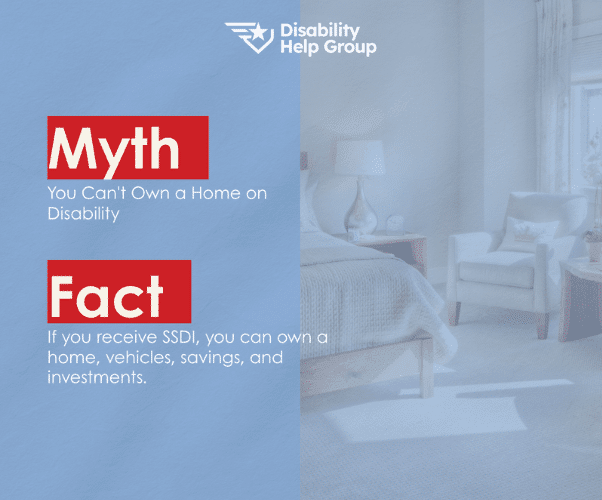
SSDI works like an insurance program, so your assets don’t disqualify you. You can have a house, a car, a retirement account, savings, investments, none of it counts against you. There’s also no limit on income from sources other than work. The one thing that matters is how much you earn from working. If your earnings from a job or self-employment go above a set monthly threshold, the SSA presumes you’re capable of substantial work and won’t consider you disabled for benefit purposes.
That threshold is called Substantial Gainful Activity, or SGA. For 2026, the SGA limits are:
- $1,690 per month for non-blind individuals (up from $1,620 in 2025)
- $2,830 per month for statutorily blind individuals (up from $2,700 in 2025)
These figures are gross earnings, before taxes, and they’re adjusted most years to keep pace with wage growth.
Trial Work Period: Testing The Waters Without Losing Benefits
If you’re already receiving SSDI and want to try going back to work, you don’t automatically lose your benefit the moment you cross the SGA line. The SSA gives you a Trial Work Period (TWP), up to nine months (they don’t have to be consecutive) within a rolling 60-month window where you can earn above SGA and still collect your full SSDI check. In 2026, any month you earn more than $1,210 counts as a TWP month. Once you’ve used all nine, your earnings going forward are measured against the standard SGA amount, and if you consistently earn above it, your benefits stop. There’s also a 36-month Extended Period of Eligibility after the TWP that offers additional protection, so a single good month at work won’t necessarily end your case.
What Can You Own on Social Security Disability: Unearned Income
Unearned income is money that is earned outside of a job. Under SSDI, you can receive income from other sources and still qualify to receive benefits.
Examples of unearned income include:
- Income from retirement accounts, dividends or stocks
- Rental income, unless you are in the business of operating rental properties
- Gifts from friends or family
- Proceeds from the sale of property
- Alimony or child support
- Contributions to or growth in an ABLE account (see below)
What Can You Own on SSI?
SSI pays monthly benefits for low-income disabled adults and children and low-income senior citizens. Because SSI is a need-based program, the SSA will consider both your income and assets in determining eligibility. To qualify, you must:
- Have less than $2,000 in countable assets (or $3,000 for a couple)
- Have very limited income
- Be a US citizen or a qualified non-citizen
Worth noting: that $2,000/$3,000 resource limit hasn’t been raised in decades. It isn’t tied to inflation, so it buys a lot less than it used to, and a modest emergency fund or an old life insurance policy can push someone over the line without them realizing it.
What Counts Towards The SSI Asset Limit?
Social Security calls assets “resources.” Resources include money, but also other types of property that have value. Resources include:
- Cash or any money in a checking or savings account
- Life insurance policies, stocks, bonds or retirement accounts
- A second car, boat, or other vehicle beyond your primary one
- Any other property that could be converted to cash and used for food or shelter
What Doesn’t Count
Several categories of property are excluded from the resource count entirely, no matter their value:
- Your home: The house you live in and the land it sits on, regardless of market value, as long as you live there (or intend to return)
- One vehicle: Your primary car or truck is excluded regardless of its value; a second vehicle is generally counted
- Household goods and personal effects: Furniture, appliances, clothing, and similar items
- Burial plots: One for you and one for each immediate family member
- Burial funds: Up to $1,500 set aside specifically for burial expenses, if not already excluded through a burial-designated life insurance policy
- Life insurance: Cash value is excluded if the combined face value of all policies on one person is $1,500 or less
If you’re navigating which of your possessions count and which don’t, the SSA’s own resource exclusions page lists the current rules in full, but the categories above cover the vast majority of situations.
ABLE Accounts: A Way To Save Without Losing SSI
An ABLE (Achieving a Better Life Experience) account lets a person who became disabled before age 26 (the age limit expands to 46 starting in 2026 under recent legislation) save money without it counting against the SSI resource limit, up to $100,000 in the account is excluded. Funds can be used tax-free for a wide range of disability-related expenses: housing, education, transportation, assistive technology, and more. For families trying to build a safety net for a disabled child or adult without jeopardizing SSI, this is one of the few legal ways to accumulate real savings.
A Plan to Achieve Self-Support (PASS)
A PASS lets you set aside income or resources toward a specific work goal, training, tuition, a vehicle to get to a job, equipment for a small business, and those set-aside funds are excluded from both the SSI income and resource calculations while the plan is active. It requires SSA approval and a written plan, but it’s a legitimate tool for someone trying to work toward independence without immediately losing benefits over savings meant for that purpose.
SSI Income Limits
To be eligible for SSI benefits, your countable income must be below the maximum federal benefit amount. For 2026, that’s $994 per month for an individual and $1,491 per month for a couple (up from $967 and $1,450 in 2025). This includes both income from work and income from other sources. If your spouse has income, some of that income may be counted. Some “in-kind” help you receive from others may also be counted.
However, some adjustments are applied to arrive at your countable income, so it may be lower than your actual income. Social Security will also reduce your countable income with certain income exclusions. For example, Social Security excludes the first $20 of unearned income and the first $65 in earned income each month. Irregular income is treated somewhat differently.
The SSA also deducts certain costs from your income. For example, if you are working and need special impairment-related work expenses, you can deduct these expenses from your income.
Other types of non-countable income include:
- Food stamps
- Tax refunds
- Public benefits based on need
- Loans that you have to repay
So, it’s worth checking your eligibility even if at first glance it seems like you have too much income or too many assets.
SSD v SSI Eligibility
In many cases, a disabled person will qualify for SSD but not for SSI, or vice versa. Here are a few examples of how that may play out:
Sara has worked for 25 years and paid into Social Security. When she becomes disabled, she has $100,000 in an investment account and significant equity in her home.
Since Sara has accumulated sufficient work credits to be eligible for SSD and is no longer able to work due to her disability, she will likely qualify for SSD. SSD isn’t need-based, so her assets won’t be a problem. However, she will not qualify for SSI because she has significant countable assets.
Joe has worked only sporadically in the past 10 years and his ability to work is now limited by a disability. He works part-time and earns $500/month. He owns a car, has $750 in the bank and does not own a home.
Joe might still be considered disabled even while earning $500 a month, since that’s below the SGA threshold. But he may not qualify for SSD if he hasn’t earned enough recent work credits.
Because his income and assets are both under the SSI limits, he may qualify for SSI. His countable income gets subtracted from the maximum federal benefit to determine his monthly payment. In 2026, the math looks like this:
$500 in earnings minus the $65 exclusion = $435 in countable income
$994 maximum federal benefit minus $435 in countable income = $559 in monthly SSI benefits
Mary has been living off of an inheritance for more than 10 years, so has no recent work credits. Now, she is in her 50s and has become disabled. Her funds are running low–she has about $50,000 remaining. But due to her disability, she cannot return to work.
In this scenario, Mary won’t qualify for either SSD or SSI. She hasn’t accrued enough recent work credits to qualify for SSD benefits, and her $50,000 disqualifies her from SSI benefits. Since she can’t return to work, she can’t become eligible for SSD. However, when her funds run out, she may be eligible for SSI.
Disability Help Group, Call Now for a Free Case Review
Figuring out which benefits you’re entitled to and how your specific assets and income will be treated gets complicated fast. There are also legal ways to structure your finances that can affect your eligibility or your benefit amount, like ABLE accounts and PASS plans. Make sure you start your claim the right way and get everything you’re owed with our trusted team of advocates. Contact us HERE for a free consultation.
Frequently Asked Questions
Does buying a house or a car affect my SSDI benefits?
No. SSDI has no asset limit at all. You can own a home, multiple vehicles, investment accounts, or anything else, and it won’t affect your SSDI eligibility or payment amount. Only your earnings from work matter for SSDI, measured against the SGA threshold.
Can I own a house and still get SSI?
Yes. The home you live in is excluded from the SSI resource count regardless of its value, as long as you live there or intend to return to it. Selling that home and not reinvesting the proceeds into another home within the same month, though, can create a problem, since the cash from the sale becomes a countable resource.
What happens if my SSI resources go even $1 over the limit?
Going over the $2,000 (or $3,000 for a couple) limit, even briefly, can suspend your SSI payments for that month. The SSA reviews resources as of the first moment of each month, so a temporary spike, like a paycheck that hasn’t been spent down yet, can matter. If you go over the limit, contact the SSA or an advocate quickly to understand your options before it turns into an overpayment.
Do retirement accounts count against SSI?
Generally, yes. Unlike SSDI, which ignores retirement savings entirely, SSI counts most retirement accounts (401(k)s, IRAs, pensions with cash value) as resources. This is one of the most common reasons someone with modest savings still gets denied SSI.
Can I have a second car and still get SSI?
You can own a second car, but only one vehicle is excluded from your resource count. A second vehicle’s value generally counts toward your $2,000/$3,000 limit unless it falls under a separate exclusion, such as being used to get a household member to necessary medical treatment.
Does an inheritance affect my benefits?
For SSDI, no. Unearned income like an inheritance doesn’t affect eligibility. For SSI, an inheritance is counted as income in the month you receive it and as a resource in every month after that. A lump sum that pushes you over $2,000 can suspend your SSI, even if you spend most of it responsibly. Some people move inheritance funds into an ABLE account or a special needs trust to avoid losing benefits.
What’s the difference between “earned” and “unearned” income for these programs?
Earned income comes from working, wages, salary, or self-employment profit. Unearned income comes from everything else: investment income, gifts, alimony, retirement benefits, rental income you don’t actively manage. SSDI cares only about earned income (via the SGA test). SSI counts both, but applies different exclusion amounts to each.
Can my spouse’s income or assets affect my SSI eligibility?
Yes. If you’re married and living with your spouse, the SSA “deems” a portion of your spouse’s income and resources to be available to you, even if they aren’t on your claim. This can reduce or eliminate your SSI eligibility even though the program is meant to be about your individual finances. It doesn’t affect SSDI at all.
Should I talk to someone before applying if I’m not sure whether my assets disqualify me?
Yes. The rules around exclusions, deeming, and countable resources have enough exceptions that it’s easy to assume you’re ineligible when you’re not, or vice versa. A free case review can clarify which program fits your situation before you file, and how a lump sum, inheritance, or property might affect your specific claim.