

Proposed SSDI Eligibility Changes Could Cut Benefits for Older Workers
Currently, the Social Security Administration (SSA) factors age into one type of Social Security disability (SSDI) determination. If the applicant meets the criteria for a listed condition in the Social Security Blue Book, age typically doesn’t play a role. If all the boxes are checked and medically documented, the applicant is deemed disabled without further consideration of their ability to work.
However, most people who receive Social Security disability don’t qualify based on a Blue Book listing. If a person doesn’t meet eligibility for disability based on meeting the criteria in a Blue Book listing, the more holistic analysis considers the difficulty older workers may have in learning new skills and entering a new field of work.
The current system breaks Social Security disability applicants into four categories:
- Younger workers – those under the age of 50
- Closely approaching advanced age – those aged 50-54
- Of advanced age – those aged 55-59
- Closely approaching retirement age – those aged 60 and older
Which category the applicant falls into is one of the variables in the grid system the SSA uses to determine disability eligibility.
How Does Age Impact Social Security Disability Determinations and Eligibility
Here are some examples of the impact age may have on the determination as to whether or not an SSDI applicant is disabled.
For Workers Limited to Sedentary Work
| Age | Education | Previous Work Experience | Decision |
| Advanced Age | Limited or Less | Skilled or semi-skilled – not transferrable | Disabled |
| Closely Approaching Advanced Age | Limited or Less | Skilled or semi-skilled – not transferrable | Disabled |
| Younger Individual | Limited or Less | Skilled or semi-skilled – not transferrable | Not Disabled |
For Workers Limited to Light Work
| Age | Education | Previous Work Experience | Decision |
| Advanced Age | Limited or Less | Skilled or semi-skilled – not transferrable | Disabled |
| Closely Approaching Advanced Age | Limited or Less | Skilled or semi-skilled – not transferrable | Not Disabled |
| Younger Individual | Limited or Less | Skilled or semi-skilled – not transferrable | Not Disabled |
For Workers Limited to Medium Work
| Age | Education | Previous Work Experience | Decision |
| Closely Approaching Retirement Age | Limited or Less | None | Disabled |
| Advanced Age | Limited or Less | None | Disabled |
| Closely Approaching Advanced Age | Limited or Less | None | Not Disabled |
| Younger Individual | Limited or Less | None | Not Disabled |
Note that these are just a few examples of situations in which the Social Security disability applicant’s age can ultimately determine their eligibility to receive benefits. It’s also important to know that in some circumstances, the categories are broken down further, and younger workers aged 45-49 are treated differently than those aged 44 and under.
For example, an illiterate individual with only unskilled work experience who was limited to sedentary work would be found disabled if they were between the ages of 45 and 49, but not if they were under 45 years of age.
Understanding SSDI “Grid Rules” and Medical-Vocational Guidelines
Many disability applicants don’t realize that age-based decisions are made using what the Social Security Administration calls the Medical-Vocational Guidelines, often referred to as the “grid rules.”
These guidelines combine several factors:
- Age
- Education level
- Work history
- Transferable skills
- Physical or mental work limitations (sedentary, light, medium, etc.)
When these factors are evaluated together, the SSA determines whether a person could realistically adjust to other work. For older workers, this system recognizes a practical reality: retraining for a brand-new career at age 55 or 60 is very different than doing so at age 30.
If proposed rule changes reduce how much weight age carries, many applicants who would currently qualify under the grid rules could be denied benefits even with the same medical limitations.
That’s why understanding how the rules work and submitting strong documentation is more important than ever.
What Changes Have Been Proposed?
The proposed rule changes would address three areas:
- Updating the Dictionary of Occupational Titles to reconcile it with more current Bureau of Labor Statistics (BLS) data
- Reassessment of thresholds for determining the availability of jobs at each exertional limit and skill level
- Changes to the way age, education and other eligibility factors are considered
While each of these changes will have an impact–some of which is unknown–it is the third item that has many advocates for the elderly and disabled most concerned about the future. One proposal has been that the age of the applicant should carry less weight than it currently does.
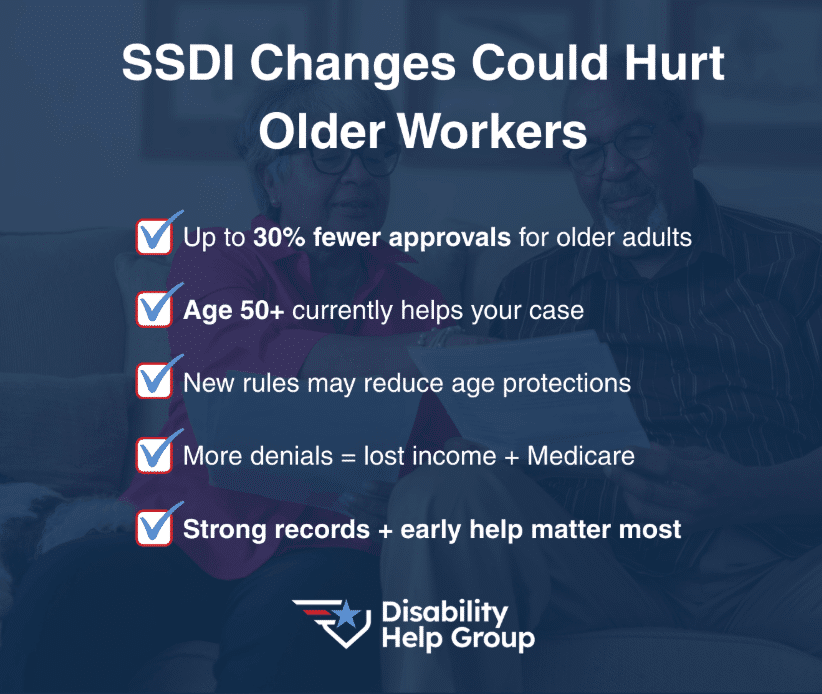
According to a report published by the Urban Institute in September, the draft rule change could reduce eligibility among older age groups by as much as 30%. Eligibility would likely decrease by 10-20 overall, though the most significant impact would be on older workers.
Even a 10% decrease in eligibility could mean hundreds of thousands of workers with limiting medical conditions who would be eligible today would lose access to Social Security disability benefits across the 10 years following the changes. That loss of eligibility would also mean loss of access to Medicare–and perhaps Medicaid–for many older Americans who have medical disabilities that limit their ability to work.
Why These Proposed SSDI Changes Matter Nationwide
While these proposals primarily affect older workers, the ripple effects could impact families across the country.
If fewer people qualify for SSDI benefits:
- More workers may be forced into early retirement
- Household incomes may drop significantly
- Access to Medicare may be delayed or lost
- Medical debt and financial hardship may increase
- Families may rely more heavily on state assistance programs
For many Americans, Social Security Disability benefits are not just income, they are also the gateway to healthcare coverage and financial stability.
Even small eligibility changes could affect hundreds of thousands of households over time.
Steps You Can Take Now to Protect Your SSDI Claim
If you are over age 50 or approaching retirement age, being proactive can make a big difference.
Consider:
- Seeing your doctors consistently and following treatment plans
- Keeping copies of medical records and test results
- Asking providers to clearly document functional limitations
- Explaining how your condition affects daily life and work tasks
- Filing your application carefully and completely
- Getting help early if you feel unsure
Well-documented claims are always stronger, and may become even more critical if eligibility standards tighten in the future.
The Impact of Social Security Disability Denials on Older Workers
Recent estimates say more than 8 million Americans aged 55-65 have medically-related restrictions on their ability to work. The administration may believe that harsher treatment of aging workers with limiting medical conditions will force them back into the workforce, but there is significant evidence to suggest that isn’t how the flood of new denials will play out.
Studies cited in the Urban Institute report revealed that among older Americans who were denied Social Security disability based on the work restriction grids, just 10 to 20% were employed five years later. Those who did find employment were typically earning significantly less than they had before becoming limited by their medical conditions.
Another study found that older workers approved for disability benefits were 20% less likely to file bankruptcy than their peers who were approved. They were also 33% less likely to face foreclosure and 15% less likely to sell their homes. That’s not just because they aren’t getting Social Security disability income, but may also be impacted by lack of access to Medicare and Medicaid and lack of access to other programs such as housing assistance, utility assistance and SNAP benefits that may be conditioned on a determination of disability.
Frequently Asked Questions About Proposed SSDI Eligibility Changes
How could the proposed SSDI rule changes affect older workers?
The proposed changes could make it harder for older workers to qualify for Social Security Disability benefits. The Social Security Administration is considering giving less weight to age in determining eligibility. Experts estimate that this could reduce eligibility for older workers by as much as 30 percent, meaning many people who currently qualify may lose access to benefits.
Why does age matter in SSDI decisions?
Under the current rules, the SSA considers age when deciding whether a person can reasonably adjust to new work. Older workers are often seen as having more difficulty learning new skills or switching careers. This age factor helps level the playing field for applicants in their 50s and 60s who have significant medical limitations but limited ability to retrain for new jobs.
What changes are being proposed to the SSDI eligibility system?
The SSA has proposed updating job listings used to determine available work, reassessing how job availability is measured, and changing how factors like age and education are considered. The biggest concern is that reducing the weight given to age could make it significantly harder for older applicants to be found disabled.
What should I do if I’m applying for SSDI now?
If you are planning to apply or have been denied, it’s important to work with an experienced Social Security disability advocate. Professional guidance can help ensure your application is complete, properly documented, and positioned for the best chance of approval, especially if eligibility standards change in the near future.
Applying for Social Security Disability? Help is Available
Because SSDI rules are complex and often changing, many applicants choose to work with an experienced advocate.
At Disability Help Group, our team helps disabled workers nationwide apply for benefits, submit appeals, and prepare evidence that clearly shows why they qualify under current Social Security rules. We’re proud to be rated among the top 7 Social Security Disability advocacy groups nationwide, and we bring that experience and dedication to every case we handle.
If you’re concerned about how proposed eligibility changes could affect you or a loved one, getting guidance early can help you avoid costly delays or denials.
Call 800-800-3332 today or request your free case evaluation through our contact form HERE to get trusted, top-rated help with your SSDI claim.