The rate of new HIV infections in the U.S. has declined dramatically in recent years. Still, more than one million Americans are currently living with HIV. Fortunately, early and consistent treatment for HIV lowers viral loads significantly, allowing many people who are infected with HIV to live normal, healthy lives and never advance to AIDS.
Because symptoms vary significantly depending on the stage of the condition, treatment, and other factors, some people with HIV/AIDS will qualify for Social Security disability (SSD) benefits and others will not.
Establishing that You Have HIV
The Social Security Blue Book sets forth specific requirements for a disability benefits applicant to demonstrate that they have HIV. The Social Security Administration (SSA) will accept positive findings on one or more of the following:
HIV antibody screening confirmed by a supplemental HIV antibody test, an immunofluorescence assay, or an HIV-1/HIV-2 antibody differentiation immunoassay
HIV nucleic detection test
HIV p24 antigen test
Isolation of HIV in viral culture
Another test that is “highly specific for detection of HIV” and “consistent with the prevailing state of medical knowledge”
Of course, establishing your diagnosis is just the first step. You must also show that your condition prevents you from engaging in substantial gainful activity (SGA), and will either continue to do so for at least 12 months or will end in death.
Proving You are Disabled by HIV/AIDS
One way to show that you are disabled due to HIV or AIDS is to meet the criteria outlined in the Blue Book. To be considered disabled based on the listing, an HIV patient must show one of the following:
Multicentric Castleman disease affects multiple groups of lymph nodes or organs containing lymphoid tissue
Primary central nervous system lymphoma
Primary effusion lymphoma
Progressive multifocal leukoencephalopathy
Pulmonary Kaposi sarcoma
Absolute CD4 count of 50 cells/mm3 or less
Absolute CD4 count of less than 200 cells/mm3 or CD4 percentage of less than 14% AND
BMI of less than 18.5, OR
Hemoglobin measurement of less than 8.0 grams per deciliter
Complications of HIV requiring at least three hospitalizations of at least 48 hours each within 12 months, at least 30 days apart
Repeated manifestations of HIV infection resulting in marked limitation of:
Activities of daily living, OR
Maintaining social function, OR
Completing tasks promptly, due to deficiencies in concentration, persistence, or pace
If you don’t meet the listing criteria, you may still be able to qualify for SSD benefits by showing the SSA that your medical condition prevents you from engaging in substantial gainful activity.
As you can see, pursuing SSD benefits for HIV/AIDS requires extensive medical documentation, and some of that documentation is complex. Working with an experienced SSD benefits advocate from the beginning can help ensure that you’re providing the documentation the SSA will be looking for to approve your claim.
“Back pain” covers a broad spectrum, from the morning ache and stiffness many people experience with age to injury-related pain that makes it impossible to engage in normal daily activities. According to the Health Policy Institute at Georgetown University, nearly 65 million Americans report recent issues with back pain. Obviously, they aren’t all eligible for Social Security disability (SSD).
In most cases, it isn’t the back pain itself that qualifies a person for SSD benefits, but the underlying injury or condition that is causing the pain.
Listed Conditions Causing Back Pain
To qualify for SSD benefits, an applicant must show that their medical condition is so severe that they are unable to engage in substantial gainful activity (SGA). There are two ways to do that. One is to meet or equal the criteria for one of the conditions listed in the Social Security Blue Book. The other is to show that your residual functional capacity is too limited to allow you to engage in SGA.
The Blue Book section on musculoskeletal conditions contains listings for some back conditions, but you may not immediately recognize whether your condition is listed. For example, the listing refers to “conditions of the skeletal spine resulting in compromise of a nerve root.” That may include conditions such as herniated discs, spondylosis, and spinal stenosis. But, they aren’t listed by name, and not every incidence of these conditions will be sufficient to meet the listing.
An experienced SSD benefits advocate can help you determine whether your condition falls within a listing, and what type of documentation will be required to establish that you meet that listing. If you don’t meet or equal a listing, you may still qualify for SSD.
Establishing Disability Outside the Listings
Sometimes, a person will meet the SSA’s definition of disability, but won’t fall within listing criteria. That may be because the medical condition is rare or newly discovered, or because it isn’t usually as serious as the applicant’s case. Or, it may be because the applicant suffers from two or more medical conditions, and is disabled by the combination rather than a specific condition.
If you don’t qualify based on a listing, the SSA will look at a combination of factors, including the level of work you are currently able to perform (residual functional capacity), your educational background, the type of work you’ve done in the past, and your age. These factors will help them determine whether there is still work you can do in spite of your medical limitations.
Medical Documentation is Critical
Whether you are aiming to show that you meet a listed condition or based on the grids, having thorough medical documentation will be critical. One challenge in securing SSD benefits for back pain is that pain doesn’t show up on an x-ray, and it can be difficult to prove how much pain limits your activities. Tests documenting the underlying condition, doctors’ notes, and other medical information is critical.
Get Help with Your SSD Claim for Back Pain
The success or failure of your SSD claim may depend on the quality of information you provide. Fortunately, you don’t have to navigate the process alone. To learn more about how our experienced disability benefits advocates can help, call 800-800-3332 or fill out our contact form here.
The Social Security Blue Book includes numerous types of cancers as listed conditions. Each of the different type listed has its own specific criteria. But it’s also possible to receive SSD benefits for cancers that aren’t listed, or when your type is listed but you don’t meet the listed criteria. It’s also possible to have an active diagnosis and not qualify for SSD because you don’t meet the Social Security Administration (SSA) definition of “disabled.”
The best way to find out whether you may be qualified for SSD and how to submit the strongest application possible is to talk to an experienced disability benefits advocate.
Cancer Claims are Similar to Other Types of SSD Claims
While the Blue Book lists criteria for many specific conditions, including many specific types of cancer, the underlying eligibility requirements for SSD are the same for everyone.
To receive SSD benefits for any condition, you must show that:
You have accrued sufficient Social Security work credits to be eligible for disability,
Your disability has lasted or is expected to last for at least 12 months or to be terminal
Like most other types of SSD claims, cancer-related claims rely heavily on medical evidence.
Some types of evidence that may be required to establish an SSD claim for cancer include:
Diagnostic records
Treatment records
Blood tests, scans, and other test results
Doctors’ notes
It can be difficult to know what information is necessary to support your SSD application. You may find that additional testing or exams are required to establish your claim. On the other hand, a records dump can be counterproductive. An experienced disability benefits advocate can help you put together the strongest documentation possible without overwhelming the reviewer.
Expedited SSD Processing
The SSA maintains a list of conditions that may qualify an SSD applicant for “compassionate allowance.” That list includes several types of cancer. The compassionate allowances program aims to identify certain types of claims and deliver a quicker decision, which can mean benefits are received sooner.
Supporting Cancer Patients Seeking SSD Benefits
Our advocates know how daunting the SSD application process can be. We also understand that the added stress is the last thing you need if you’re fighting cancer or managing another debilitating medical condition. We’ve developed an in-depth knowledge of the SSD application and appeals processes so you don’t have to. To learn more about how we can help, call us today at 800-800-3332 or fill out our contact form here.
If you suffer from a disability and live in the U.S. you may be entitled to Social Security Disability benefits. For this to happen the Social Security Administration must deem your disability severe enough that you cannot engage in “Substantial Gainful Activity”
The SSA evaluates your medical condition by looking at the “Listing of Impairments” and assessing your work-related limitations. The “Listings” outline each major body system, and provide requirements necessary for proving disability. Many of the listed impairments are permanent or likely to result in death.
For all other conditions, the SSA assesses your medical evidence which must demonstrate that your disorder will last at least 12 months and prevent you from working at any job.
What Are The Most Common Disabilities?
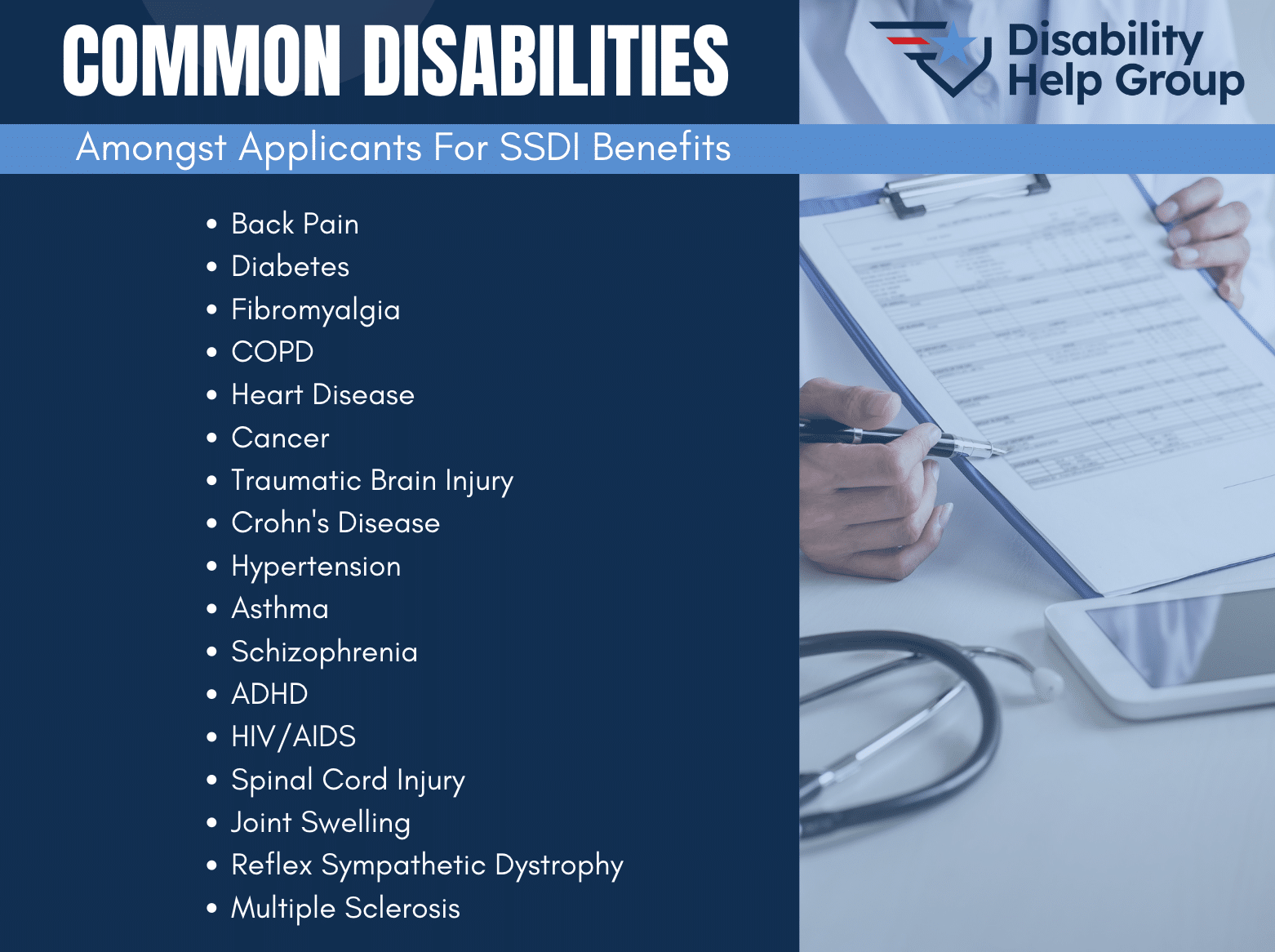
The list below will show you the type of medical conditions/disabilites that are the most common among SSD benefit applicants. (This list is based on the SSA’s Blue Book.)
Cancer
Cardiovascular Systems
Congenital Disorders That Affect Multiple Body Systems
Digestive System
Endocrine System Disorders
Hematological Disorders
Genitourinary Disorders
Immune System Disorders
Mental Disorders
Musculoskeletal System
Neurological Disorders
Respiratory Disorders
Skin Disorders
Special Senses and Speech
Get The Help You Need To Secure SSD Benefits
At Disability Help Group, we work hard to build a strong medical file to support your SSD claim. We will request your medical records and medical evaluations from your doctors and give you the best chance of receiving the benefits you deserve. Contact our team of experts today here or call us at 800-800-3332.
You probably know that a U.S. worker who is medically unable to work may be eligible for Social Security disability (SSD) benefits. If a worker meets the SSA’s definition of “disabled” and has accumulated sufficient work credits, they may receive a monthly benefit in the same amount they would have received in retirement benefits. After two years, a disabled worker on SSD is also eligible for Medicare coverage.
What you may not know is that certain family members of an SSD recipient may also be eligible for benefits. Here’s what you need to know about who qualifies and how benefits are determined.
Who Can Get SSD Family Benefits?
Under certain circumstances, the following family members of disabled workers may receive benefits:
A spouse who has been married to the SSD recipient for at least one year
A former spouse who was married to the SSD recipient for at least 10 years
An unmarried minor child of the SSD recipient
An unmarried child of the SSD recipient who is 18 or 19 years old but still in high school
An unmarried disabled adult child of the SSD recipient
Under certain limited circumstances, other family members may be eligible for benefits.
In the most recent year reported, the Social Security Administration (SSA) paid SSD family benefits to more than 90,000 spouses and former spouses and more than 1.1 million children of SSD recipients. The vast majority of those children were under the age of 18.
There are some additional requirements for a spouse or former spouse to be eligible for SSD family benefits. The spouse or former spouse must also either:
Be at least 62 years of age
Be disabled
Be caring for a child younger than 17, or
Be caring for a child 17 or older who is disabled
How are SSD Family Benefits Determined?
Unlike many other types of benefits, SSD benefits are determined based on the individual disabled workers’ past earnings and contributions. Since SSD family benefits are based on the disabled workers’ benefits, that means those benefits also vary based on the SSD recipient’s past earnings.
An eligible family member may receive up to 50% of the SSD recipient’s monthly benefit amount. However, total family benefits are capped. So, if there are multiple family members who qualify for benefits, the benefit amounts may be reduced so as not to exceed the cap. However, benefits paid to a former spouse don’t count toward the family maximum.
Disability Help Group is Here for You
The seasoned advocates at Disability Help Group work hard every day to make sure disabled workers and their families have access to the benefits they’ve earned. To learn more about how we can help your family, call 800-800-3332 or fill out our contact form here.