

Complete Guide to Winning Your SSD Case
You’ve probably heard that most Social Security disability (SSD) applications are initially denied. What you may not realize is that there are steps you can take to improve your chances of approval at every stage of the process, from your original application through reconsideration, the ALJ hearing, and beyond.
The better prepared you are before you submit your SSD application, the more smoothly the process is likely to go. The best first step toward submitting the strongest application possible is to work with an experienced Social Security disability benefits advocate from the beginning. Or, if your initial claim has already been denied, reach out for knowledgeable guidance before you take the next step in the appeals process.
Applying for Social Security Disability
To begin, it’s important to understand what “disabled” means to the Social Security Administration (SSA) and what type of evidence they’ll be looking for.
To qualify for SSD, an applicant must show that they have a medical condition that:
- Has lasted or is expected to last for at least one year, or is expected to be fatal
- Prevents them from engaging in substantial gainful activity (SGA)
- Is documented by one or more medical professionals
The applicant must also have sufficient work credits and sufficient recent work credits to be eligible for disability benefits.
Technical Requirements
The number of work credits and recent work credits required to qualify for SSD depends on the age at which you became disabled. Most people need 40 total credits and at least 20 credits earned within the 10 years leading up to the disability, but the requirements are lower for younger workers.
You can earn up to four work credits per year. The dollar amount of earnings required to earn one credit changes from year to year. In 2026, you earn one credit for every $1,890 you earn, up to a total of four ($7,560) in a year. You can check your work credits on the SSA website before you get started. If the count looks wrong to you, a disability benefits advocate can help you take inventory and get the record corrected.
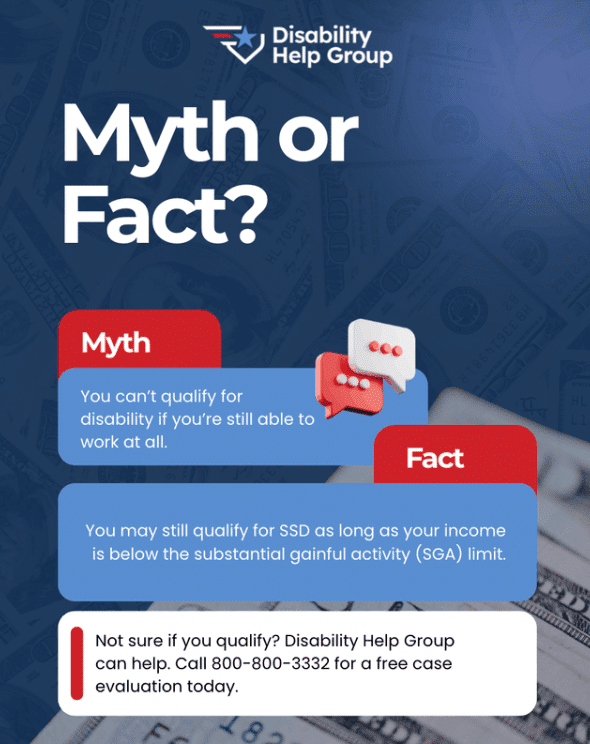
The SSA will also look to see whether you are currently engaged in substantial gainful activity by checking your earnings from work against the SGA cut-off. In 2026, the cut-off is $1,690/month for most applicants, and $2,830/month for blind applicants. Note, though, that this is just a preliminary screening. The SSA will deny your application if your income from work exceeds the threshold. But you could be earning below the cut-off–even earning nothing at all–and still be found able to engage in SGA.
Medical Requirements
It’s up to you to demonstrate to the SSA that your medical condition or combination of conditions leave you unable to engage in SGA. There are two different ways to do that, but they have one important thing in common: they depend heavily on the medical documentation you provide.
The first is to meet or equal a listing in the Social Security Blue Book. Blue Book listings contain very specific medical requirements, such as specific measurements on particular medical tests. Submitting your claim without all of the medical documentation required to meet a listing may result in denial, even though you actually meet the criteria.
If the applicant doesn’t qualify based on a Blue Book listing, the SSA moves on to a different type of analysis, first determining whether you can still do the type of work you did before and, if you cannot, moving on to determine whether there is other work you can do. This analysis takes into account factors like your age, educational level, and past work experience.
| Requirement Type | Criteria | Key Details |
|---|---|---|
| Medical Eligibility | Severe disability | Must prevent substantial gainful activity (SGA) for at least 12 months or be expected to result in death |
| Work Credits | Based on age | Typically 40 credits total, with 20 earned in the last 10 years |
| Earnings Threshold (SGA) | Income limit | $1,690/month (non-blind), $2,830/month (blind) |
| Work Credit Value (2026) | Earnings per credit | $1,890 per credit (max 4 per year) |
| Medical Evidence | Documentation required | Must include records from medical providers, test results, and treatment history |
Application Procedures
You can apply for Social Security disability through the SSA website, by dropping off a paper application at a local office, or even by phone. But in 2026, the SSA is increasingly pushing to move as many operations as possible online, and that is typically the quickest way to get a decision. As of February of 2026, the average wait time for a decision on an initial application was 193 days, or about 6.5 months.
However, the process can take longer if the SSA needs to request additional information–another reason to be very sure you are providing all necessary documentation with your initial application. If you do receive a request from the SSA, it is important that you respond promptly with the information they have requested and cooperate with any additional requests, such as scheduling a medical exam.
| Stage of SSD Process | What Happens | Average Timeline | Approval Tips | Common Mistakes to Avoid |
|---|---|---|---|---|
| Initial Application | Submit your Social Security Disability (SSD) claim online, by phone, or in person | ~193 days (6.5 months) | Submit complete medical records, include all conditions, and ensure work history is accurate | Missing medical evidence, incomplete forms, underreporting symptoms |
| Reconsideration | A different SSA reviewer evaluates your claim | 2–4 months | Submit updated medical records, new diagnoses, or additional documentation | Failing to add new evidence, assuming SSA already has all records |
| ALJ Hearing (Appeal) | Hearing before an Administrative Law Judge (ALJ) | 8–12+ months wait | Get representation, prepare testimony, bring expert opinions and witnesses | Going unprepared, not understanding what the judge is evaluating |
| Appeals Council | Review of ALJ decision if denied | 6–12 months | Focus on legal errors in the ALJ decision | Submitting no new argument or evidence |
| Federal Court Review | File a lawsuit in federal court if necessary | Varies (often 1+ year) | Work with experienced SSD attorneys or advocates | Filing without legal support |
What if My SSD Application is Denied?
If you receive a denial on your initial Social Security disability application, the most important thing you can do is stick with the process. A great many people who are initially denied receive benefits later in the process. If you miss your appeal deadline and have to start over, you could lose out on back benefits.
At each stage, there are different steps you can take to improve your chances of approval. For example, the first step in the SSD appeals process is to request reconsideration. Reconsideration is just a fresh look at your application by a different person. However, you can submit additional information with your request for reconsideration, such as updated medical records. Most people don’t take advantage of this opportunity, which is one reason approval rates are low at the reconsideration stage.
If you are denied on reconsideration and need to request an ALJ hearing, you will want representation. Even if you have handled the process on your own up to this point, you should contact an experienced SSD advocate right away. The ALJ hearing offers opportunities to present witnesses, offer additional evidence, and even question the ALJ’s witnesses. But taking full advantage of those opportunities requires extensive knowledge of the process and the type of evidence that will be most useful.
To learn more about how the experienced SSD benefits advocates at Disability Help Group can help, call us today at 800-800-3332 or fill out our contact form HERE now!
Frequently Asked Questions (FAQ) About Winning an SSD Case
What is the fastest way to get approved for Social Security Disability?
The fastest way to get approved for SSD benefits is to submit a complete and well-documented application from the start. This includes detailed medical records, consistent treatment history, and clear proof that your condition prevents you from working.
Why are most SSD applications denied initially?
Most initial SSD claims are denied due to lack of medical evidence, incomplete applications, or failure to meet technical requirements like work credits or income limits.
How can I improve my chances of winning my SSD case?
You can improve your chances by:
- Providing strong medical documentation
- Following all SSA instructions carefully
- Responding quickly to requests
- Working with an experienced disability advocate
What happens if my SSD claim is denied?
If your SSD claim is denied, you can appeal through reconsideration, request a hearing with an Administrative Law Judge (ALJ), and continue through higher levels of appeal if necessary.
Do I need an advocate for my SSD case?
While not required, having representation significantly improves your chances, especially at the ALJ hearing stage, where legal strategy and evidence presentation are critical.
How long does it take to win an SSD case in 2026?
The process can take several months to over a year depending on whether appeals are needed. Initial decisions average about 6.5 months, while hearings can add additional time.