

Compassionate Allowances: 14 New Conditions Added to Fast Track Disability List
It’s no secret that the Social Security disability application and approval process can take a very long time. That leaves many applicants in a tough position, as they may have no income while they wait for Social Security disability benefits to be approved or fight their way through the appeals process.
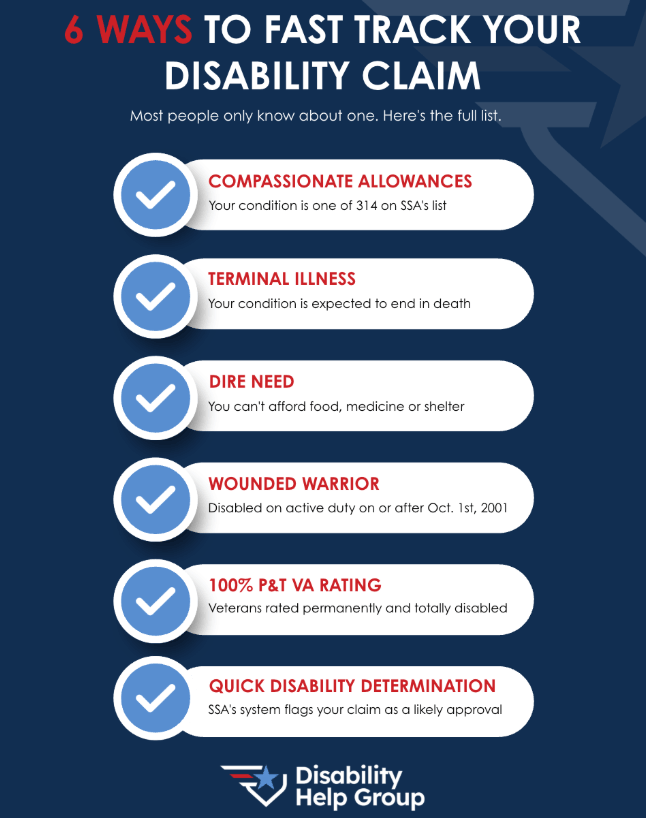
For some disability applicants, there is a lifeline available. The Social Security Administration (SSA) maintains a Compassionate Allowances List (CAL). The Compassionate Allowances program is designed to expedite benefits approval for those with the most serious disabilities. The program was rolled out in 2008 with a list of 50 conditions. That list has been updated multiple times since. In August 2026, SSA added 14 more conditions, bringing the total to 314. According to SSA, more than 1.2 million people with severe disabilities have been approved through the program since it started.
New Conditions Added to the Compassionate Allowances List in 2026
SSA announced the latest additions on August 11, 2026. The 14 new conditions are:
- Adenylosuccinate Lyase Deficiency – Neonatal Form and Type 1
- Aicardi Syndrome
- Baraitser-Winter Syndrome
- Beare-Stevenson Cutis Gyrata Syndrome
- Bohring-Opitz Syndrome
- CASK-Related Gene Disorders
- Hepatosplenic T-Cell Lymphoma
- Lafora Disease
- Malignant Migrating Partial Seizures of Infancy (MMPSI)
- OPHN1 Syndrome
- Primary Cardiac Sarcoma
- Primary Intracranial Malignant Melanoma
- Uveal Melanoma – with Metastases
- Warburg Micro Syndrome
Several of these are rare genetic conditions that show up in infancy or early childhood, which matters for families applying for SSI on a child’s behalf. Others, like the cancers on this list, can strike adults in the middle of their working lives.
Conditions Added in 2025
The 2026 additions came a year after SSA added 13 conditions in August 2025:
- Au-Kline Syndrome
- Bilateral Anophthalmia
- Carey-Fineman-Ziter Syndrome
- Harlequin Ichthyosis – Child
- Hematopoietic Stem Cell Transplantation
- LMNA-related Congenital Muscular Dystrophy
- Progressive Muscular Atrophy
- Pulmonary Amyloidosis – AL Type
- Rasmussen Encephalitis
- Thymic Carcinoma
- Turnpenny-Fry Syndrome
- WHO Grade III Meningiomas
- Zhu-Tokita-Takenouchi-Kim Syndrome
You can find the full list of 314 conditions that may qualify a Social Security disability applicant for expedited processing under the Compassionate Allowances program on the Social Security website.
How Does the Compassionate Allowances Program Work?
The term “compassionate allowances” can be a bit misleading. The Compassionate Allowances program doesn’t provide any additional benefits for a qualifying applicant, and it doesn’t allow someone who might otherwise not be eligible to qualify for Social Security disability benefits. Instead, the process is designed to allow the SSA to quickly identify applicants with certain very serious or terminal medical conditions and bump them to the front of the line for processing.
How Do I Get Considered for Expedited Processing?
There are multiple ways to qualify for expedited processing for Social Security disability. If you are eligible for expedited processing under the Compassionate Allowances program, you shouldn’t have to do anything to request expedited processing. The system aims to identify your potential qualification and speed up processing on its own. SSA uses software to scan applications for CAL conditions, and in some cases it receives your medical records electronically from your providers through its Health IT program, which speeds things up further. However, neither the technology used to flag CAL applications nor the humans reviewing them are perfect.
An experienced Social Security disability benefits advocate can help ensure that you are considered under the Compassionate Allowance program if you qualify. For example, your advocate can explain exactly what language and level of detail is necessary to allow the SSA’s technology to identify your application as one that may qualify for quicker processing.
One practical tip: SSA publishes a short summary for each CAL condition, linked from its conditions list, that describes the medical evidence it expects to see, such as specific test results or a pathology report. Making sure those exact records are in your file is one of the simplest ways to avoid a delay.
Your disability benefits advocate can also help you determine whether you may qualify for expedited processing for another reason. For example, you may be entitled to quicker processing if:
- You have a terminal illness
- You can establish that you are in dire financial need
- You became disabled while on active military duty on or after October 1, 2001 (often called Wounded Warrior status)
- You’re a veteran with a 100% permanent and total (P&T) disability rating from the VA
SSA also runs a separate fast track called Quick Disability Determinations, which uses a computer model to spot claims that are very likely to be approved based on the information in the application. You don’t apply for it. Like CAL, it happens behind the scenes, which is why a complete, clearly written application matters so much.
You Must Still Prove Eligibility for Social Security Disability
It’s important to understand that the fast track process for applicants with listed conditions doesn’t change the criteria for Social Security disability. Though your application can be slated for quicker processing, it will still be up to you and your advocate to show that you meet the SSA’s criteria for disability by providing appropriate medical records and other evidence. You must also meet technical requirements such as having accumulated sufficient work credits across your career and in the 10 years leading up to your disability.
Does the CAL Apply to Supplemental Security Income (SSI) Applicants?
The SSA uses the Compassionate Allowances List for SSI applications in the same way it does for Social Security disability applications. An SSI applicant may qualify for expedited processing if they have been diagnosed with one of the 314 conditions on the CAL.
SSI applicants with certain severe conditions may also qualify for presumptive disability payments. That means SSA can start paying SSI for up to six months while it finishes reviewing the claim. If SSA ultimately decides you aren’t disabled, you generally don’t have to pay those benefits back.
How Much Faster is the Expedited Process?
How quickly the expedited process moves forward depends on a variety of factors, including the office processing your claim, whether your application is promptly identified as qualified for quick processing, how quickly your medical records arrive and how thorough your evidence is. In some cases, you may receive a determination in a matter of days. More often, the determination may take a few weeks or a month. In some cases, it may take a few months.
There is one catch, though. No matter how quickly your application may be reviewed and approved, the five-month waiting period for Social Security disability benefits still applies. This usually isn’t an issue for disability applicants because that time has passed or nearly passed by the time they receive a determination. When processing is expedited, that may not be the case.
How Does the Five-Month Waiting Period Work?
A Social Security disability benefits applicant will not receive benefits for the first five full calendar months after they become disabled. Note, though, that the SSA will count that five months starting from the date they determine that you became disabled, even if you hadn’t yet applied for benefits.
For example, if you became disabled with a condition on the CAL in January and then didn’t apply for benefits until June and got approved in July, you would be eligible to start collecting benefits right away. On the other hand, if you became disabled in January, applied in February and were approved in March, you would have to finish out the five-month waiting period before you started collecting benefits.
Two exceptions are worth knowing. The waiting period no longer applies to people with ALS, which is on the CAL. And it doesn’t apply to SSI at all. SSI benefits generally start the month after you apply, so a fast SSI approval can mean money arrives sooner.
Talk to a Disability Benefits Advocate
When you’re applying for Social Security disability, you’ll want to take advantage of every opportunity to move your application forward quickly and to improve your chances of a quick approval. An experienced disability benefits advocate can guide you through the process and ensure that you are providing the information the SSA will be looking for in the format and language that will be easiest for them to identify and work with.
Call Disability Help Group today at 800-800-3332 or fill out our contact form to learn more.